
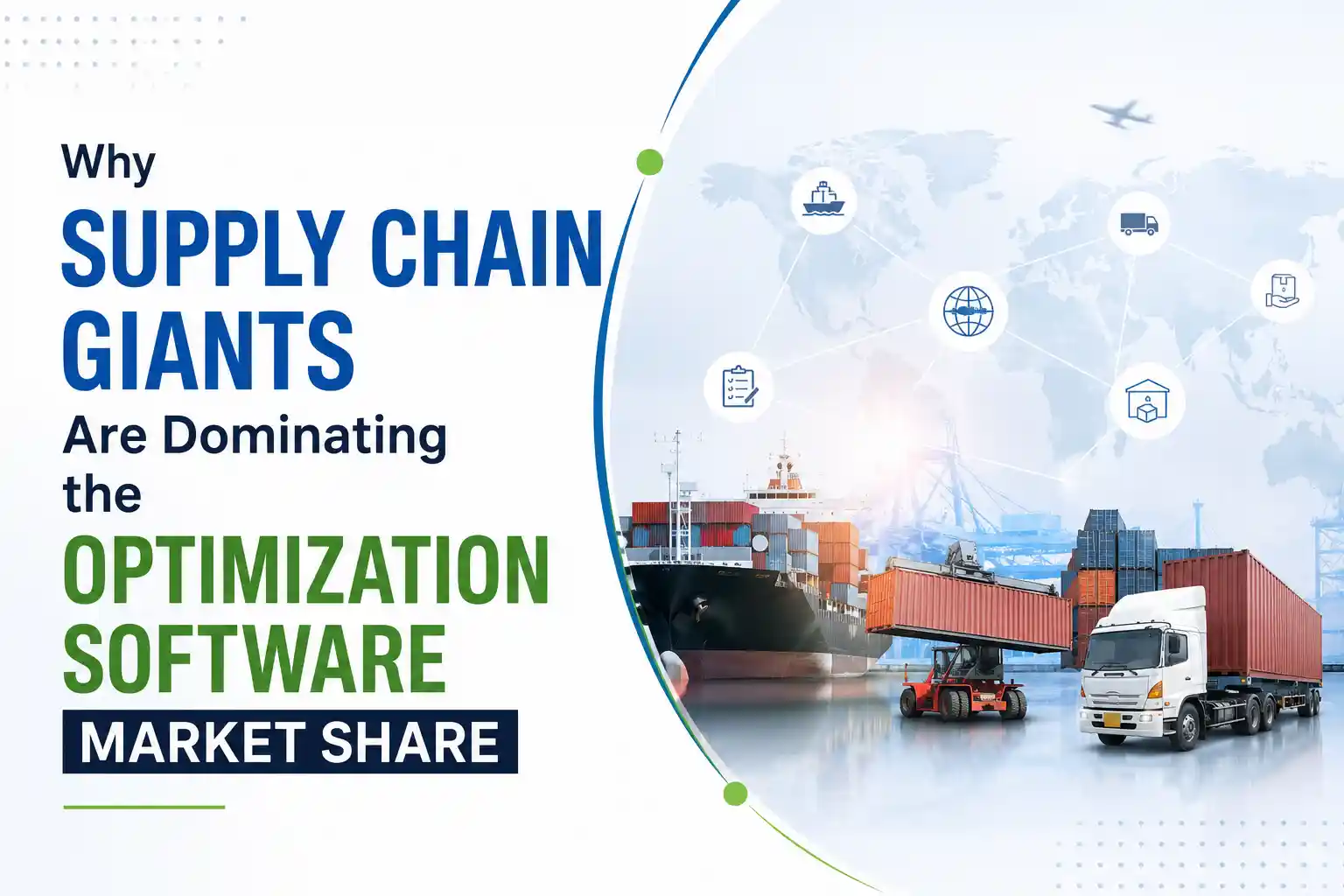
Why Supply Chain Giants Are Dominating the Optimization Software Market Share (2026 Deep Audit)
Ten years ago, buying supply chain software meant dealing with a pure-play SaaS company. You bought your trucks and shipping capacity from logistics providers, and you bought the software to manage them from tech vendors in Silicon Valley.
That firewall no longer exists.
Today, the companies building the physical infrastructure of global trade, like Amazon, Maersk, DHL, and massive 3PLs, are aggressively absorbing the optimization software market. They are transforming from logistics operators into tech vendors, and they are pushing standalone software companies out of the market.
This isn’t just a trend of deep-pocketed buyers buying out startups. It is a fundamental shift in how predictive algorithms are built, trained, and sold.
The Shift from Pure-Play SaaS to “Operator-as-a-Vendor”
The shift from pure-play SaaS to operator-as-a-vendor occurs when physical logistics giants build or acquire supply chain optimization software. Because these operators own the physical assets, they use their proprietary operational data to create superior predictive software, effectively displacing standalone technology companies in the market.

The traditional SaaS model relies on selling a platform and waiting for customers to populate it with data. The “Operator-as-a-Vendor” model skips that step entirely. Logistics giants are commercializing the software they originally built to manage their own massive networks.
When you buy optimization software from a supply chain giant, you aren’t just buying code. You are buying access to the insights generated by their physical assets.
The Unfair Advantage of Data Gravity
Data gravity is the primary advantage logistics giants have over standalone SaaS vendors. Machine learning models require vast amounts of historical and real-time physical data to accurately predict supply chain disruptions. Logistics operators inherently possess this data from their physical networks, creating an insurmountable moat for independent tech firms.
An algorithm is only as intelligent as the data feeding it. An independent tech startup might hire the best engineers in the world to build route optimization software. However, they must rely on APIs, third-party data brokers, or delayed customer inputs to train their models.
A global shipping line or a massive 3PL has direct access to millions of live data points. They know exactly how long a container sits at the Port of Long Beach. They know the actual dwell times at specific warehouses. This proprietary data gravity allows them to build digital twins and predictive models that a standalone software company physically cannot replicate.
The “Live Sandbox” Testing Ground
Logistics giants possess a “live sandbox” testing ground, meaning they can beta-test new supply chain software directly on their own massive global networks before bringing it to market. This ensures the software is battle-tested in real-world conditions, an advantage pure software companies lack.
When a standalone software vendor pushes a major update, they beta-test it with a few willing clients. When an operator-vendor pushes an update, they test it across their own fleet of 10,000 trucks. They refine the optimization logic against real fuel costs, real driver shortages, and real weather delays before they ever sell it to a customer.

How Asset-Heavy Giants Are Crushing Standalone Tech Firms
Asset-heavy logistics giants are crushing standalone tech firms through aggressive mergers and acquisitions (M&A) and by subsidizing software costs. Because operators make their primary revenue from moving freight, they can offer software at steep discounts, outpricing independent tech vendors who rely solely on subscription revenue.
The market consolidation we are seeing isn’t an accident. It is a calculated strategy to lock in enterprise customers. Logistics giants are using two distinct levers to capture market share from independent tech vendors.
Strategic M&A and Aggressive Consolidation
Supply chain operators are dominating market share through strategic M&A, acquiring leading standalone software platforms rather than building from scratch. This allows giants to instantly capture the software vendor’s customer base while integrating the acquired technology into their own physical logistics ecosystems.
Instead of competing with the best Transportation Management Systems (TMS) or visibility platforms, the giants simply buy them. We have seen massive capital deployed to acquire specialized tech firms. Once acquired, the software is integrated into the giant’s broader service offering, making the standalone product a feature of a larger logistics package.
Subsidized Software Pricing Models
Logistics giants can offer subsidized software pricing models because their primary profit comes from freight and warehousing, not software subscriptions. They frequently discount or bundle optimization software to win physical logistics contracts, making it impossible for pure-play SaaS companies to compete on price.
If an independent SaaS company lowers its subscription price, it directly impacts its valuation and survival. If a logistics giant lowers the price of its software, it doesn’t matter—as long as the software convinces the customer to route their multi-million dollar freight spend through the giant’s physical network. The software is effectively a loss-leader used to capture highly profitable freight volume.
The Hidden Risks for Software Buyers
Buying supply chain software from logistics giants carries hidden risks, primarily regarding data privacy and vendor lock-in. Companies must evaluate whether using an operator’s software means exposing their proprietary supply chain data and vendor pricing to a potential competitor or limiting their future carrier choices.
While the technology offered by these massive operators is objectively powerful, enterprise buyers are walking into a complex trap. Procurement teams must look beyond the software’s features and understand the strategic implications of who owns the code.
The Competitor Data Conflict
The competitor data conflict arises when a company uses optimization software owned by a logistics giant that also acts as a freight carrier. Buyers risk exposing their entire supply chain network, including competitive carrier rates and customer locations, to the operator supplying the software.
If you are a global retailer and you use a supply chain visibility platform owned by a major ocean carrier, you are feeding your entire network map into their servers.
The giant promises data siloing, but boardrooms are increasingly skeptical. Do you really want your primary logistics provider to have granular visibility into the rates you negotiate with their direct competitors? Independent SaaS vendors use this exact fear as their primary sales tactic, pushing “neutrality” as their core value proposition.
Ecosystem Traps and Vendor Lock-In
Ecosystem traps and vendor lock-in occur when software built by a logistics giant is optimized to work best with that giant’s physical assets. Switching carriers becomes incredibly expensive and disruptive because the company’s entire digital infrastructure is tied to a specific logistics provider.
Software dictates behavior. Optimization algorithms built by an operator often subtly favor the operator’s physical network. Once a shipper integrates their ERP with an operator-owned tech stack, decoupling becomes a multi-year, multi-million-dollar nightmare. The software creates a sticky relationship that guarantees the giant retains the physical freight business for years to come.
Evaluating Supply Chain Software in 2026
Evaluating supply chain optimization software requires choosing between independent neutrality and operator-backed scale. Buyers must weigh the superior predictive data and subsidized pricing of logistics giants against the data privacy, flexibility, and unbiased routing offered by standalone SaaS vendors.
Procurement teams must change how they run RFPs. The decision is no longer just about user interface and API limits. It is a strategic decision about data sovereignty versus algorithmic power.
Independent Vendors vs. Operator-Backed Tech
To clarify the decision-making process, organizations should weigh their specific needs against the reality of the two vendor profiles.
| Evaluation Metric | Independent SaaS Vendor | Operator-Backed Software |
| Market Neutrality | High. Agnostic to which carriers you use. | Low. Often incentivized toward their own network. |
| Algorithm Training Data | Limited to customer inputs and public APIs. | Massive. Fueled by billions of proprietary physical data points. |
| Data Privacy Risk | Low. They only sell software. | High. They compete in the logistics space. |
| Pricing Leverage | Rigid. Dependent on software revenue. | Flexible. Can be bundled with freight contracts. |
| Best For | Shippers prioritizing multi-carrier flexibility and data privacy. | Shippers want the most accurate predictive models and deep integration. |
The standalone software vendors that survive the next five years will be the ones that double down on neutrality. They will position themselves as the “Switzerland” of supply chain data. Meanwhile, the logistics giants will continue to leverage their physical scale to build algorithms that smaller tech firms simply cannot match. The winner of this market share war won’t be decided by who has the best code, but by who controls the most real-world data.
The Shift from Recommendation to Autonomous Execution
The industry is moving from software that simply recommends actions to software that autonomously executes them. Supply chain giants dominate this shift because autonomous execution requires the optimization engine to have direct write-access to core transactional systems, a capability natively held by major ERP and SCM providers.
Providing a dashboard that tells a planner to “move 50 pallets from Chicago to Dallas” is no longer enough. The market demands that the software make a decision and automatically book the freight.
Pure-play vendors struggle with autonomous execution because IT security teams are deeply hesitant to give third-party point solutions “write-access” to core ERP systems. The giants already have the keys to the castle. Because they own the entire environment, their optimization engines are trusted to execute trades, re-route shipments, and adjust pricing autonomously.
What This Market Consolidation Means for Software Buyers
For buyers, market consolidation means prioritizing vendor ecosystem compatibility over niche algorithmic perfection. Companies must evaluate if the marginal performance gain of a standalone optimization tool outweighs the severe integration risks, often finding that adopting their existing vendor’s native modules yields a higher ROI.
If you are a supply chain director or IT architect looking to invest in optimization software, the current market dynamics force a specific evaluation framework:
-
Audit your data maturity: If your core data is fragmented, a brilliant standalone optimizer will fail. Fix the core first.
-
Calculate the Total Cost of Ownership (TCO): Do not just compare software license costs. Factor in the cost of building, securing, and maintaining custom APIs for a standalone tool over five years.
-
Evaluate the 80/20 rule: Does the giant’s native optimization module solve 80% of your complex problems? If yes, the lack of API friction makes it the superior business choice over a niche tool that solves 95% of the problem but breaks every quarter.
The era of siloed, mathematical brilliance in supply chain software is ending. The future belongs to integrated execution.