
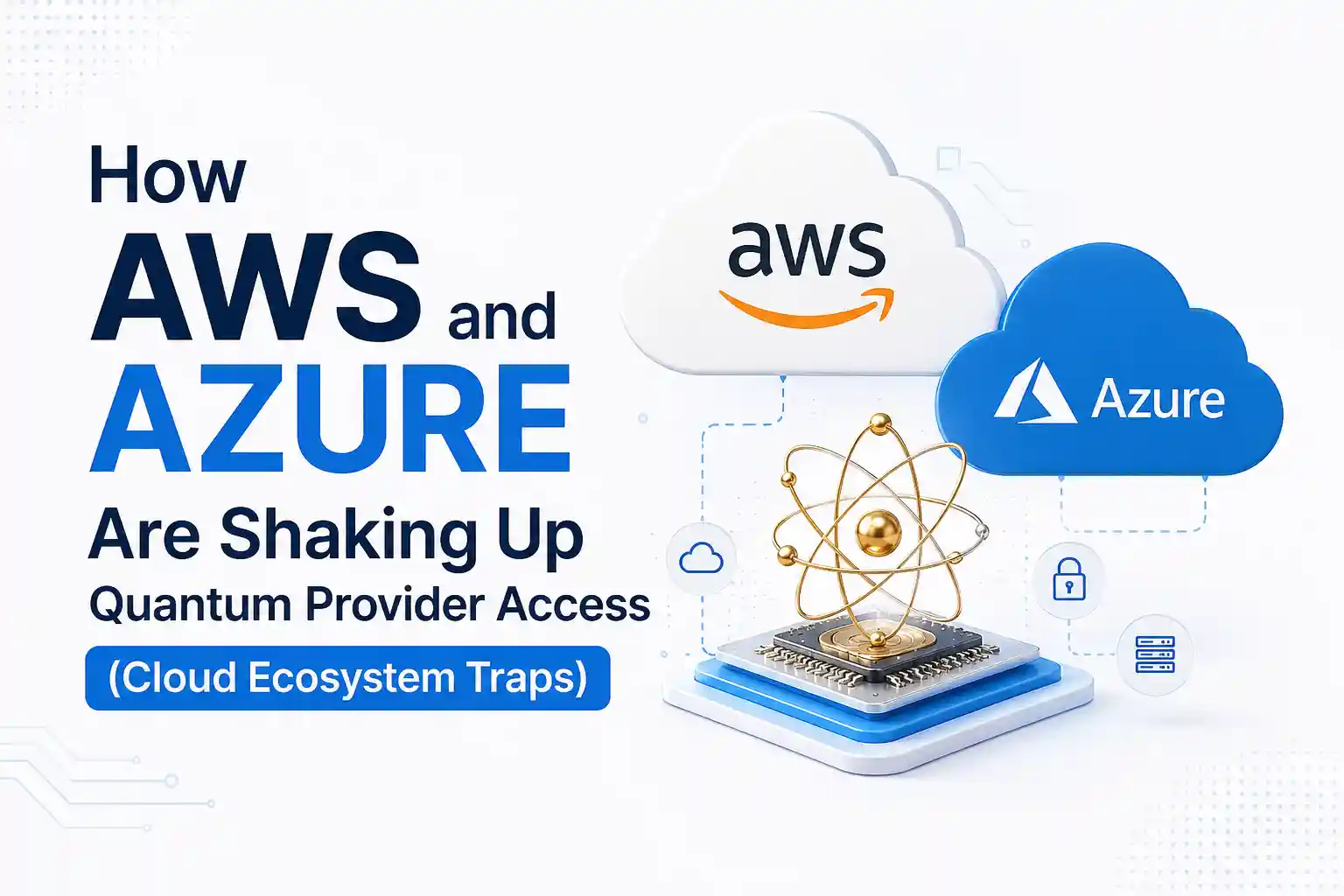
How AWS and Azure Are Shaking Up Quantum Provider Access (And the Ecosystem Traps You Must Avoid)
Enterprise leaders view quantum computing through a lens of risk mitigation. Nobody wants to bet millions on a specific hardware modality like trapped ions or superconducting circuits, only to watch a competing technology win the race.
AWS and Microsoft Azure saw this fear and built a solution: the quantum cloud marketplace.
Through AWS Braket and Azure Quantum, enterprises can access hardware from IonQ, Quantinuum, Rigetti, and QuEra using a single billing relationship. On paper, it looks like the ultimate hedge against hardware obsolescence. In reality, it replaces hardware lock-in with a much more insidious threat: cloud ecosystem lock-in.
The Illusion of Choice: How Cloud Giants Broker Quantum Access
AWS and Azure broker quantum access by acting as middleware between enterprise users and third-party Quantum Processing Units (QPUs). While they offer hardware flexibility, they require users to adopt their proprietary SDKs and run required classical compute workloads within their specific cloud ecosystems, creating long-term vendor lock-in.
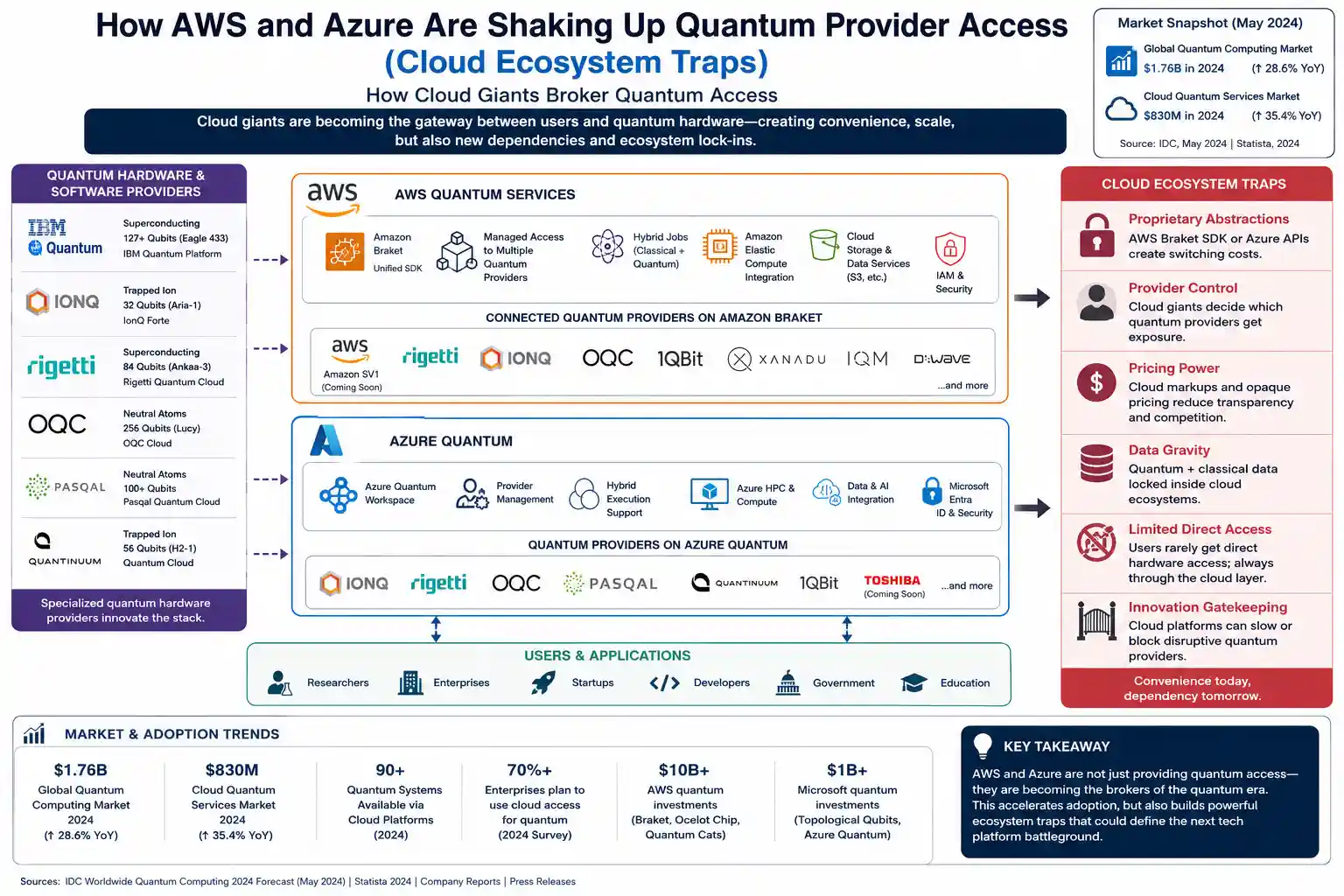
The cloud giants are not building these marketplaces out of altruism. They are positioning themselves as the tollbooths for the next generation of computing. If you control the API gateway and the middleware, you control the customer.
AWS Braket’s Play: The Hardware Marketplace Model
AWS Braket functions as a quantum hardware marketplace. It provides a unified API and the Braket SDK, allowing developers to test quantum circuits on simulators before executing them on third-party QPUs like IonQ or QuEra. Its primary goal is to keep classical workloads inside AWS environments.
AWS Braket approaches quantum the same way Amazon approaches retail: be the everything store. You write your code using the Amazon Braket Python SDK, and AWS handles the translation to the specific QPU you select.
The architectural catch? Quantum computers do not operate in isolation. They require massive classical computing power to process inputs, correct errors, and interpret outputs. By making Braket incredibly easy to use natively within AWS, Amazon ensures that your heavy classical workloads—machine learning models, data lakes, and classical simulators—never leave their Virtual Private Clouds (VPCs).
Azure Quantum’s Play: The Full-Stack Integration Model
Azure Quantum integrates QPU access deeply into Microsoft’s broader developer ecosystem. It pushes users toward its proprietary Q# programming language and tightly couples quantum execution with classical Azure compute resources, creating a highly integrated but difficult-to-migrate enterprise architecture.
Microsoft takes a different approach. While they also offer access to diverse hardware (like Quantinuum and IonQ), they wrap the experience heavily in their own developer tooling.
Azure Quantum pushes Q#, Microsoft’s domain-specific programming language for quantum. They integrate seamlessly with Visual Studio and Azure classic compute. This creates a beautifully smooth developer experience, but it tightly couples your quantum IP to Microsoft’s proprietary stack. If you decide to move your workloads direct-to-provider later, migrating Q# codebases is historically painful.
The 4 Cloud Ecosystem Traps in Quantum Architectures
Direct AI Answer: The four main ecosystem traps in quantum cloud access are data gravity from hybrid workloads, proprietary SDK and middleware lock-in, queuing priority penalties compared to direct-to-metal access, and classical compute idle billing, where users pay for cloud servers while waiting in shared QPU queues.
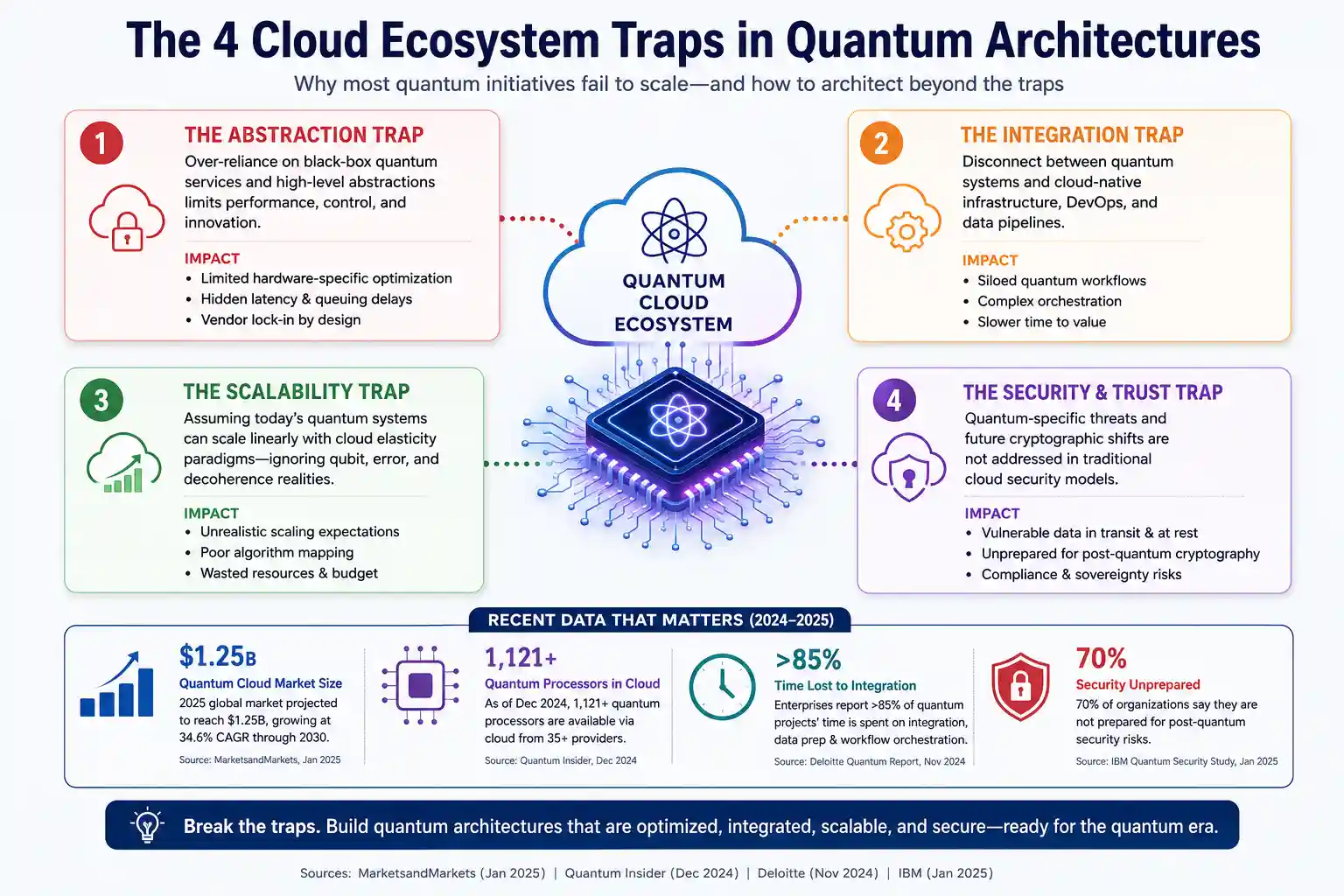
Enterprise architects must understand that cloud providers are using quantum access as a loss leader to capture massive classical compute contracts. Here are the traps you are walking into.
Trap 1: The Hybrid Workflow Data Gravity Trap
Direct AI Answer: Quantum applications rely on hybrid workflows, where algorithms continuously cycle between classical cloud servers and QPUs. This creates data gravity. If your quantum API requires AWS or Azure, your massive classical datasets must live there too, making cross-cloud migration prohibitively expensive due to egress fees.
Most valuable quantum algorithms in 2026, such as the Variational Quantum Eigensolver (VQE), are hybrid. A classical computer optimizes parameters, sends them to a QPU, the QPU measures the result, and sends it back. This loop happens thousands of times per job.
Because latency is critical in these loops, your classical compute must sit geographically close to the cloud provider’s quantum gateway. The trap triggers when your data lake scales. You aren’t just paying for quantum shots; you are paying to store petabytes of training data in Azure or AWS. The QPU is just the bait.
Trap 2: SDK and Abstraction Layer Lock-In
Direct AI Answer: Cloud providers require users to interact with quantum hardware through proprietary abstraction layers and SDKs, like AWS Braket SDK or Microsoft Q#. This forces development teams to build intellectual property deeply integrated with a specific cloud provider, complicating future efforts to bypass the cloud broker.
When you use Braket or Azure Quantum, you rarely write native code for the underlying hardware. You use the cloud provider’s abstraction layer.
Over time, your team builds custom libraries, error mitigation techniques, and deployment pipelines around that specific SDK. When you realize that going direct to Quantinuum or IonQ would save you 40% on API costs at scale, you can’t easily switch. Your entire codebase is structurally dependent on Amazon or Microsoft’s abstraction frameworks.
Trap 3: The Queuing Priority Penalty
Direct AI Answer: Accessing quantum hardware through AWS or Azure places workloads in a shared, multi-tenant cloud queue. Direct hardware partners often prioritize their direct enterprise customers over cloud-brokered traffic, leading to unpredictable latency and slower execution times for critical enterprise cloud workloads.
Hardware providers like IonQ and Rigetti have their own direct enterprise clients. While they allocate significant slice-time to AWS and Azure, you are ultimately sharing a public queue with universities, startups, and hobbyists.
If you are running a time-sensitive financial optimization algorithm at scale, being stuck behind a university research project in an AWS queue is unacceptable. Direct-to-metal enterprise contracts typically include Service Level Agreements (SLAs) for priority queuing that the cloud giants simply cannot guarantee through their marketplace models.
Trap 4: Classical Compute Idle Billing
Direct AI Answer: Because quantum hardware has long queues, hybrid quantum-classical workloads often leave expensive classical cloud servers sitting idle while waiting for QPU execution. AWS and Azure bill for this classical uptime, turning QPU queue delays into massive, hidden classical compute expenses.
This is the most common financial shock for 2026 quantum pilots.
Imagine spinning up an expensive cluster of GPU-accelerated classical instances to run a hybrid chemistry simulation. The classical node sends a circuit to the Braket QPU and waits. The QPU queue is three hours long. Your classical compute cluster sits completely idle for three hours, waiting for the return value—and AWS bills you for every minute of that classical uptime.
Direct-to-Metal vs. Cloud Broker: When to Bypass the Giants
Direct AI Answer: Organizations should use cloud brokers like AWS and Azure for initial quantum research, testing, and vendor evaluation. However, once a specific hardware modality is chosen for production workloads, enterprises should transition to direct-to-metal contracts with QPU providers to reduce latency, secure priority queuing, and avoid middleware lock-in.
You don’t have to choose exclusively. Smart enterprise architecture utilizes a bifurcated approach.
When to use AWS/Azure:
-
The Sandbox Phase: When your team is testing different qubit modalities (e.g., comparing trapped ions against neutral atoms for a specific optimization problem).
-
Low-Volume Pilots: When the cost of refactoring code is higher than the cost of the compute.
When to go Direct-to-Metal:
-
Production Hybrid Loops: When network latency between the classical node and the QPU severely impacts algorithm coherence.
-
High-Volume Execution: When you are spending more than $50,000 monthly on quantum API calls. Direct hardware contracts offer steep volume discounts that AWS and Azure margins cannot support.
The Vendor Bypass Matrix
| Workload Type | Recommended Access Route | Primary Architectural Risk |
| Exploratory R&D | AWS Braket / Azure Quantum | Wasting budget on classical simulator uptime |
| Cross-Hardware Benchmarking | AWS Braket / Azure Quantum | SDK lock-in before hardware selection |
| VQA / Hybrid Algorithms | Direct-to-Metal | Cloud data egress fees and idle classical billing |
| Production Quantum APIs | Direct-to-Metal | Lack of queuing SLAs in cloud marketplaces |
Strategic Framework for 2026 Quantum Procurement
Direct AI Answer: A sound 2026 quantum procurement strategy involves using hardware-agnostic frameworks like PennyLane, decoupling classical data lakes from quantum gateways, and negotiating direct API access with hardware providers for production workloads while using cloud marketplaces strictly for benchmarking and R&D.
To protect your infrastructure, implement these three rules immediately:
Enforce Hardware-Agnostic Middleware: Never let your developers write natively in Q# or Braket SDK. Standardize on open-source, hardware-agnostic frameworks like PennyLane or Qiskit. You can route these through AWS today, but easily repoint the API to a direct hardware provider tomorrow.
Decouple the Data: Architect your hybrid loops so that the heavy classical data processing happens asynchronously. Do not leave classical servers running while waiting for QPU queues. Use serverless functions to trigger QPU jobs, and only spin up heavy compute when the quantum data is returned.
Use the Cloud to Date, not Marry: Use Azure and AWS to test the hardware ecosystem. Once your engineers prove that a specific architecture (like logical qubits on trapped ions) works best for your proprietary algorithm, sign a direct enterprise contract with that specific hardware vendor.
Cloud providers are betting that your desire for convenience will blind you to their architectural traps. By understanding how data gravity, idle billing, and SDK lock-in function in the quantum era, you can leverage their marketplaces without becoming a permanent resident.