
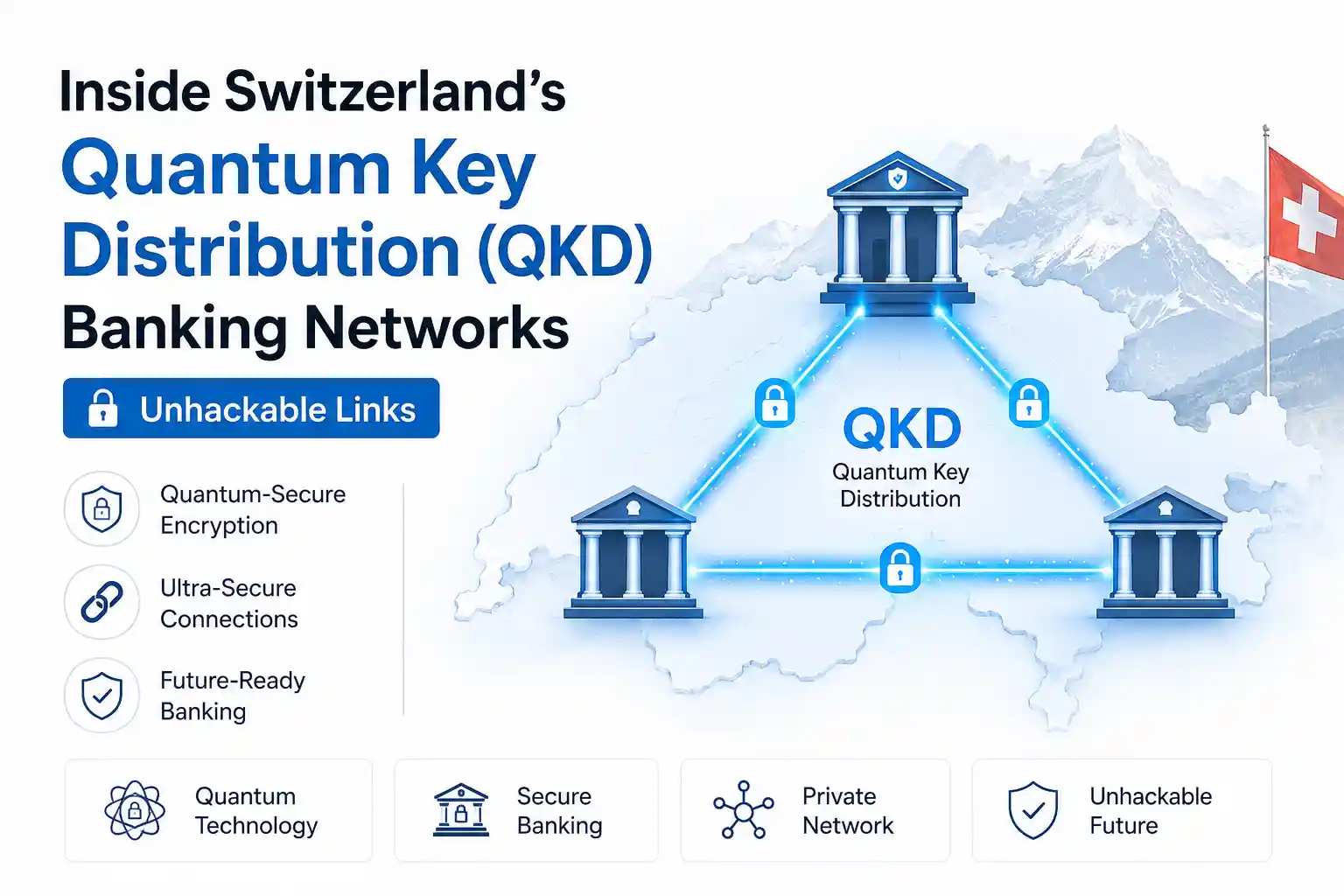
Inside Switzerland’s Quantum Key Distribution (QKD) Banking Networks
Financial institutions face a definitive expiration date on current encryption standards. As quantum computing advances, the RSA and Elliptic Curve algorithms protecting global wire transfers, client identities, and inter-bank settlements will become obsolete.
Switzerland has engineered a physical defense. Swiss banks, government agencies, and telecom providers have built a functional Quantum Key Distribution (QKD) network. This infrastructure relies on the fundamental laws of quantum mechanics to transmit cryptographic keys that cannot be intercepted without immediate detection.
This is the exact architecture, hardware, and operational reality of the Swiss quantum-safe banking backbone.
The Store Now, Decrypt Later Threat to Financial Systems
“Store Now, Decrypt Later” (SNDL) is a cyberattack strategy where state-sponsored or highly funded actors harvest and store currently encrypted financial data. They retain this data until quantum computers become powerful enough to break the encryption algorithms, exposing the historical data.
The urgency behind Switzerland’s QKD adoption is not an immediate quantum hack. It is the SNDL threat model.
Petabytes of encrypted data are traversing global networks daily. Intelligence agencies and criminal syndicates scrape this encrypted traffic from fiber-optic tap points. The data is useless today. However, a sufficiently powerful quantum computer running Shor’s algorithm will eventually crack standard public-key cryptography.
For Swiss banks, which stake their existence on absolute client confidentiality and long-term asset protection, historical data exposure is catastrophic. A hacked transaction record from 2024 will still ruin a reputation in 2034.
How QKD Creates an Unhackable Physical Layer
QKD secures data at the physical hardware layer using single photons sent over fiber-optic cables. Because observing a quantum state alters it, any attempt by a hacker to intercept the keys instantly changes the photon, alerting the system and invalidating the compromised key.
Traditional encryption relies on complex mathematics. QKD relies on physics.
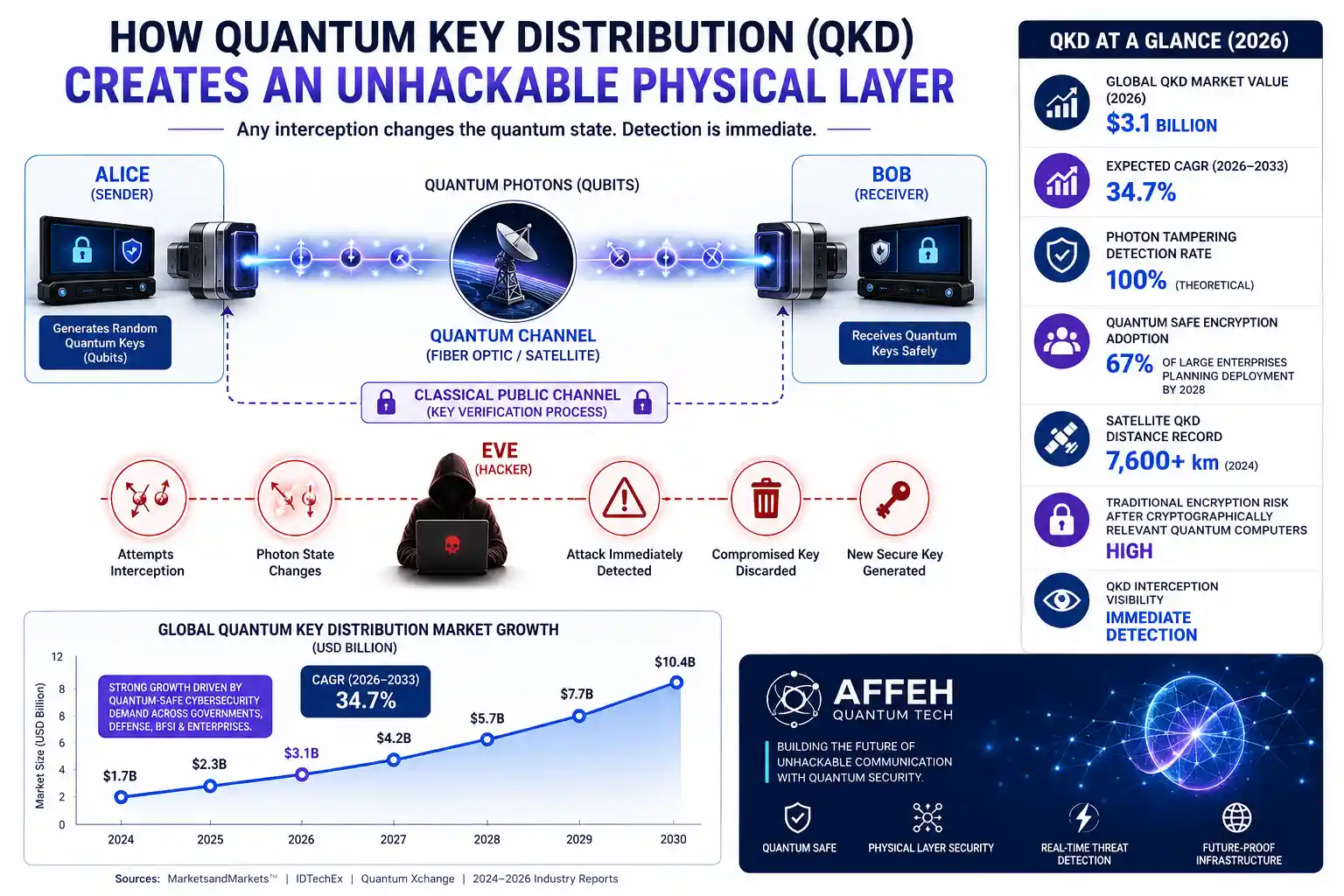
In a QKD network, two data centers (let’s call them Alice and Bob) need to exchange a symmetric encryption key. The QKD hardware generates single photons and assigns them a specific polarization state (representing a 1 or a 0). These photons are fired across a dedicated dark fiber link.
Photon Polarization and Intrusion Detection
QKD uses photon polarization to detect eavesdropping. If a hacker intercepts the fiber-optic cable, the act of measuring the photon inevitably changes its quantum state. The receiving server detects this elevated error rate and immediately drops the compromised key before any data is sent.
If a hacker splices the fiber cable and tries to read the photons, they trigger the Heisenberg Uncertainty Principle. The mere act of observation alters the photon’s state.
When the receiving bank gets the photons, it compares a small subset of the data with the sending bank over a public channel. If the error rate exceeds a specific threshold (typically around 11%), the system knows an eavesdropper is on the line. The key is destroyed. The encrypted banking data is never sent.
The Swiss Advantage: Why Geneva and Zurich Lead the World
Switzerland leads in QKD implementation due to its dense geography and local hardware pioneers. The short distances between financial hubs like Geneva, Zurich, and Bern bypass QKD’s current distance limitations, while companies like Geneva-based ID Quantique provide the localized hardware infrastructure.
QKD has a severe physical limitation: distance. Single photons degrade over long runs of standard telecom fiber. Without using repeaters—which break the quantum state and introduce security vulnerabilities QKD maxes out at roughly 100 to 150 kilometers.
This renders a direct New York to London QKD link physically impossible today.
Switzerland’s geography solves this. The major financial centers are clustered closely together. A bank can link its primary trading floor in Zurich to a disaster recovery bunker in the Swiss Alps without exceeding the distance constraints of photon transmission.
ID Quantique and the Swisscom Dark Fiber Backbone
Swisscom provides the dedicated dark fiber infrastructure, while ID Quantique supplies the Cerberis XG hardware nodes. Together, they create a commercial, quantum-safe backbone linking Swiss data centers, allowing banks to lease secure channels without building proprietary fiber networks.
Geneva-based ID Quantique (IDQ) has been the central catalyst for this network. Rather than banks laying their own cables, telecom giant Swisscom provides the multiplexed fiber network. IDQ provides the hardware endpoints.
Modern QKD systems, like IDQ’s Cerberis series, no longer require dedicated, single-use dark fiber. They can multiplex the quantum channel alongside classical data channels on the same fiber strand. This drastically reduces the capital expenditure required for a bank to adopt the technology.
QKD Hardware vs. Post-Quantum Cryptography (PQC)
QKD is a hardware-based solution relying on quantum physics to secure key distribution, while PQC is a software-based algorithmic solution designed to withstand quantum computer attacks. Financial institutions require both QKD for physical infrastructure and PQC for application-layer software.
The banking sector cannot rely on QKD alone. It requires a hybrid approach.
| Feature | Quantum Key Distribution (QKD) | Post-Quantum Cryptography (PQC) |
| Mechanism | Physical hardware and fiber optics | Mathematical algorithms |
| Primary Use | Inter-data center links, core backbones | Web traffic, mobile banking apps |
| Cost | High capital expenditure | Low (software updates) |
| Distance Limit | ~150km (without trusted nodes) | Unlimited |
| Vulnerability | Trusted node physical security | Future math breakthroughs |
You cannot install a QKD photon emitter in a customer’s iPhone. Therefore, mobile banking and consumer web portals will rely on PQC algorithms (like those recently standardized by NIST). The core banking backbones—where billions of dollars settle daily between institutions rely on QKD.
The “Trusted Node” Vulnerability Nobody Talks About
The primary weakness in a QKD network is the “trusted node.” Because quantum signals degrade over distance, long networks require intermediary nodes to decode and re-encode the key. These nodes represent a classical vulnerability and must be heavily physically secured.
QKD is theoretically unhackable in transit, but the endpoints remain vulnerable.
To bridge distances longer than 150km, the network must use “trusted nodes.” At these intermediary locations, the quantum key is briefly converted back into classical data, copied, and converted back into a quantum state for the next leg of the journey.
If a nation-state attacker physically compromises the trusted node facility, they can steal the keys. Consequently, Swiss banks place these trusted nodes inside military-grade bunkers, treating the physical security of the node with the same rigor as a vault holding physical gold.
Implementing QKD: Costs, Latency, and Architecture
Implementing QKD requires high upfront costs for specialized endpoint hardware and dark fiber leasing. However, modern QKD systems introduce near-zero latency, making them viable for high-frequency algorithmic trading networks where even millisecond delays are unacceptable.
For a Swiss financial institution, implementing QKD is an infrastructure project, not an IT patch.
Hardware Acquisition: Deploying QKD endpoints costs tens of thousands of dollars per link.
Fiber Leasing: The bank must secure high-quality, low-loss fiber paths from providers like Swisscom.
Integration: The QKD devices do not encrypt the data themselves. They act as a highly secure delivery mechanism for the keys. These keys are then fed into standard Layer 2 hardware encryptors (like encrypting network switches) via standardized APIs.
The critical advantage for the financial sector is latency. Because the encryption remains symmetric (using the keys generated by the QKD system), the actual data encryption and decryption happen at line speed. High-frequency trading firms can operate over QKD links without suffering the computational overhead and latency associated with complex asymmetric cryptography.