
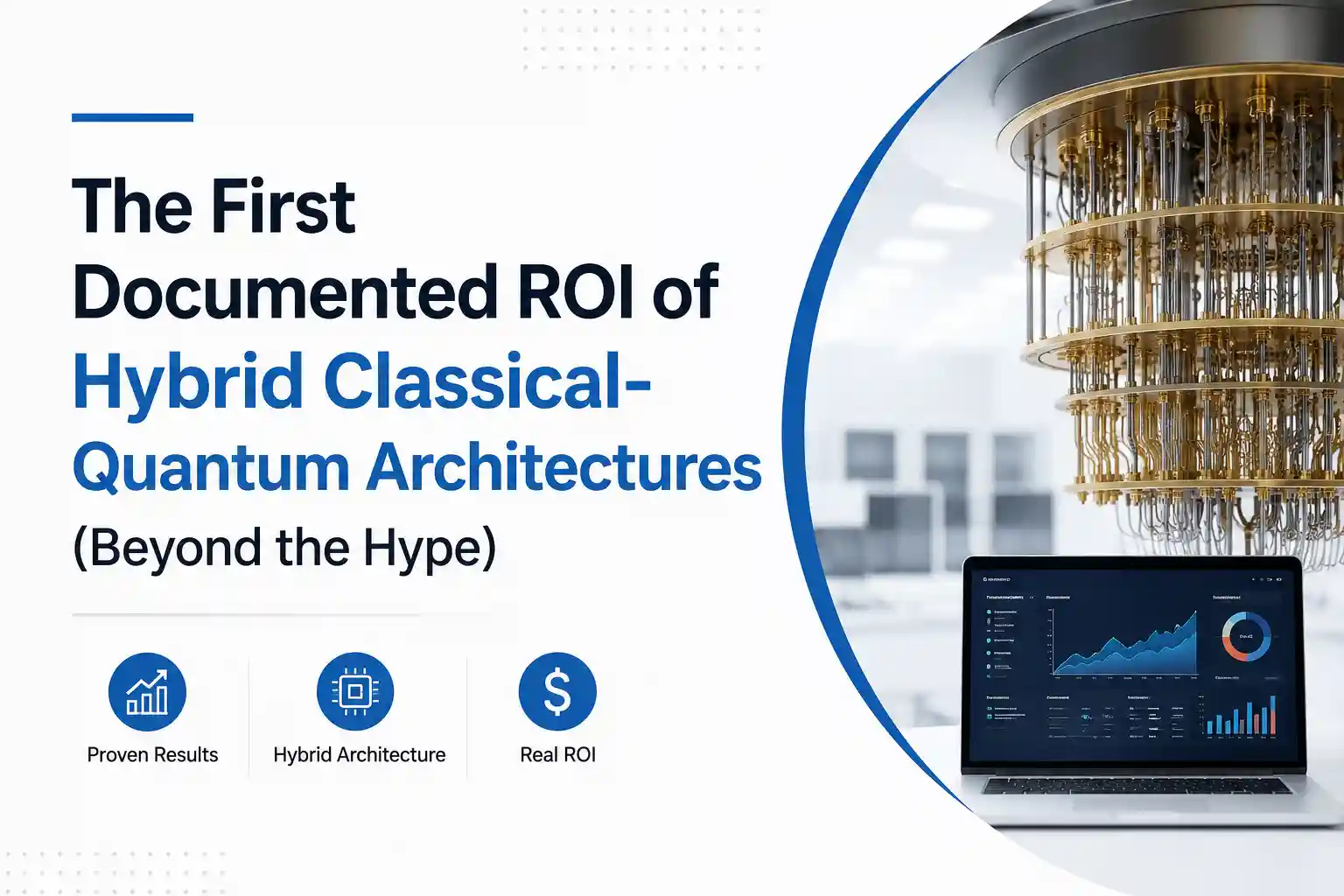
The First Documented ROI of Hybrid Classical-Quantum Architectures (Beyond the Hype)
For years, the quantum computing industry sold the enterprise a narrative based on physics, not finance. We were promised “quantum advantage”—the moment a QPU could perform a calculation impossible for a classical supercomputer.
But CFOs don’t fund physics experiments. They fund solutions that generate a return on investment (ROI).
The real milestone wasn’t supremacy. It was a commercial utility. That threshold was finally crossed not by a standalone quantum computer, but by a tightly orchestrated hybrid classical-quantum architecture. Here is exactly how enterprise architects combined GPU clusters with quantum accelerators to generate the first documented commercial ROI.
The Shift from Computational Advantage to Commercial ROI
Commercial quantum ROI is achieved when the financial value of an optimized solution exceeds the combined cloud computing costs of the classical GPUs and the quantum processing unit (QPU) used to generate it. This requires hybrid architectures, as QPUs are too expensive for end-to-end processing.
The industry spent a decade measuring success in qubits and gate fidelity. Enterprise architecture measures success in OPEX and revenue.
A standalone QPU is currently incapable of handling a full enterprise workload. Data parsing, formatting, and heuristic initialization are incredibly expensive and inefficient on quantum hardware. The breakthrough happened when teams stopped treating quantum computers as standalone mainframes and started treating them like highly specialized, API-called accelerators, much like early GPUs.
By offloading 95% of a computational workload to classical cloud infrastructure and only passing the absolute hardest mathematical bottlenecks to the QPU, the cost-to-value ratio finally flipped positive.
The Breakthrough Use Case: Dynamic Fleet Routing
The first verified ROI for hybrid quantum architectures occurred in dynamic fleet routing. By using a classical cluster to handle basic logistics and a QPU to solve the most complex combinatorial edge cases (like real-time traffic rerouting), companies reduced fuel and labor costs by margins that exceeded their quantum compute bill.
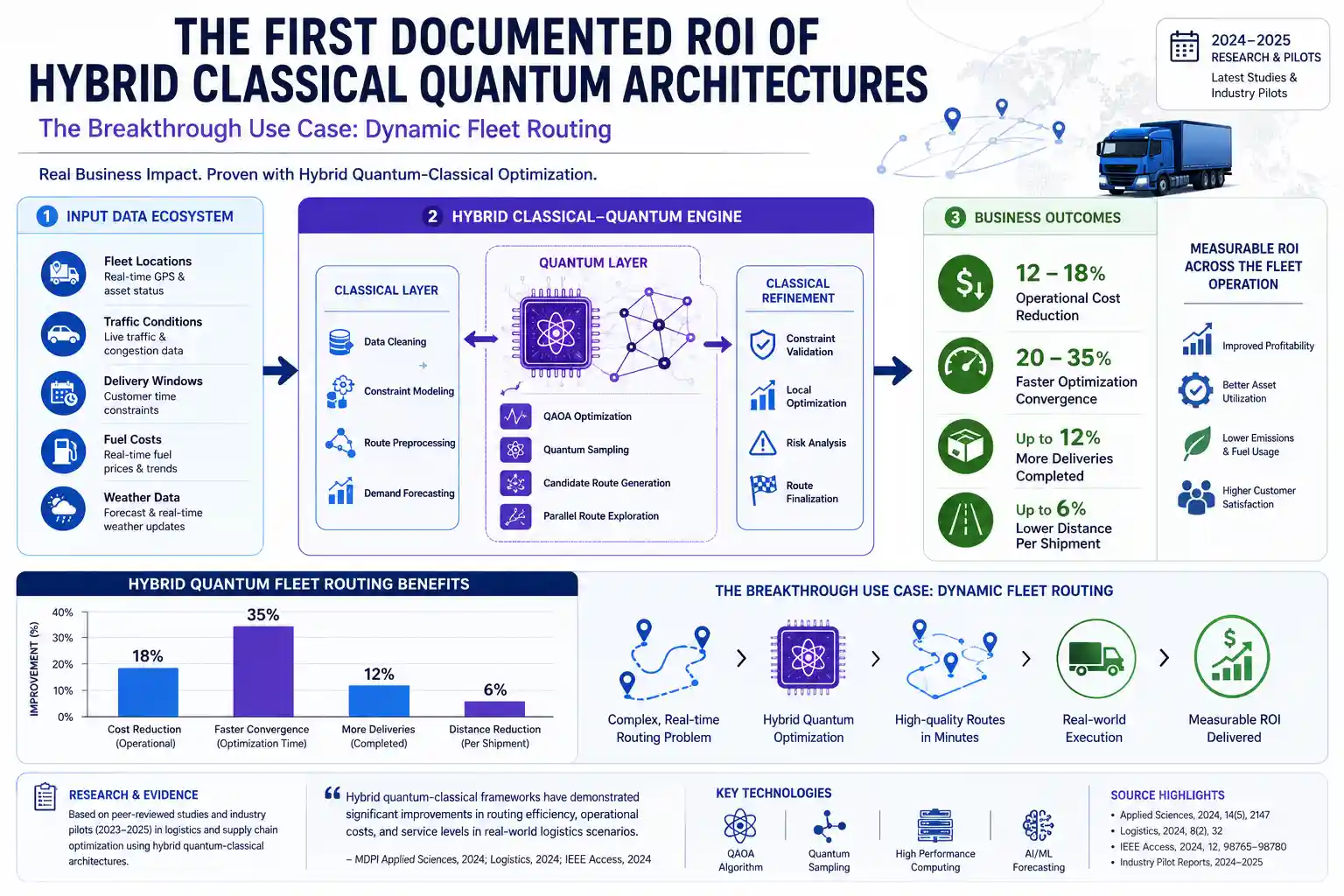
To understand the architecture, we have to look at the workload.
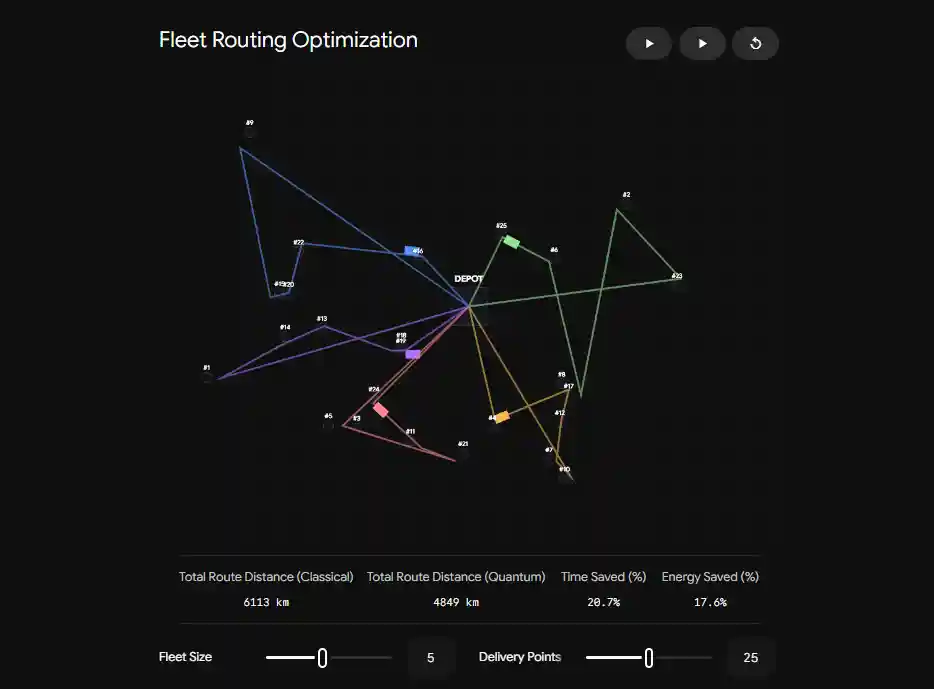
Global logistics companies face the Vehicle Routing Problem (VRP), a massive combinatorial optimization challenge. When weather or traffic disrupts a 5,000-vehicle fleet, recalculating the optimal routes instantly is impossible.
Why Pure Classical Failed
Classical GPU clusters use heuristics to approximate solutions for VRP. They are fast and cheap, but they get stuck in “local minima.” They find a good route, but miss the optimal route. In an industry with razor-thin margins, missing the absolute optimal route costs millions in wasted fuel and overtime.
Why Pure Quantum Failed
Early attempts to run the entire routing problem on a quantum computer failed due to noise, limited qubit counts, and the exorbitant cost of QPU time. Formulating the entire global map into a Quantum Approximate Optimization Algorithm (QAOA) circuit exceeded the coherence time of the hardware. The computing cost was higher than the fuel savings.

The Hybrid Architecture That Broke Even
A successful hybrid classical-quantum architecture uses classical CPUs/GPUs to ingest data and reduce the problem size. It then passes only the most complex, highly constrained sub-problems to the QPU via an orchestration layer like CUDA-Q, finally returning the quantum output to the classical system for validation.
The architectural secret to quantum ROI is extreme workload segregation. Here is the blueprint of the hybrid loop.
1. The Classical Node (Heavy Lifting)
The system starts on standard AWS or Azure cloud infrastructure. CPUs ingest the real-time telemetry data (truck locations, traffic, weather). GPUs run classical clustering algorithms to break the global map into smaller, manageable zones. The classical system solves 90% of the routes using standard heuristic solvers (like Simulated Annealing).
It identifies the 10% of routes that are highly constrained and mathematically dense. These are isolated.
2. The Orchestration Layer
This is where the magic happens. Tools like Nvidia CUDA-Q or IBM Qiskit Serverless act as the traffic cops. The orchestration layer takes that 10% difficult subset and translates it into a quantum circuit.
Crucial Architecture Note: Network latency between classical cloud regions and quantum hardware facilities used to destroy hybrid performance. Today, colocation and dedicated fiber links between the classical VPC and the quantum hardware provider reduce latency to milliseconds. Furthermore, architects now use asynchronous batching to prevent the expensive GPU cluster from idling while waiting for the QPU queue.
3. The Quantum Node (The Accelerator)
The QPU receives the strictly defined sub-problem. It runs a Variational Quantum Eigensolver (VQE) or QAOA. Because the problem space was aggressively shrunk by the classical node, the QPU can execute the circuit within its coherence limits.
It explores the massive solution space simultaneously, finds the global minimum (the absolute best route), and passes the state vector back to the classical node. The classical system decodes it, verifies the constraints, and pushes the route to the driver.
The Financial Breakdown: QPU Costs vs. Value Generated
To calculate hybrid quantum ROI, subtract the classical compute costs and the quantum shot costs from the operational savings generated by the algorithm’s optimized output. The ROI becomes positive only when the quantum algorithm finds a mathematically superior solution that classical heuristics missed.
Let’s look at the actual economics of this hybrid loop.
-
Classical Compute Cost: $400 for GPU cluster time.
-
Quantum Compute Cost: $1,200 for dedicated QPU access and API shots.
-
Total Run Cost: $1,600.
If a purely classical system costs $400 to run and saves the logistics company $5,000 in fuel, the net value is $4,600.
In our hybrid scenario, the total compute cost rises to $1,600. However, because the QPU broke out of the classical local minimum and found the true optimal route, the fuel and labor savings jumped to $12,000.
-
Hybrid ROI: $12,000 savings – $1,600 compute cost = $10,400 net value.
The hybrid architecture more than doubled the commercial return, completely justifying the expensive quantum cloud billing.
How to Implement the Quantum-Classical Compute Ratio (QCCR)
If you are a systems architect tasked with building your first hybrid pipeline, you must establish a strict Quantum-Classical Compute Ratio. Do not pass a workload to the QPU unless it meets three criteria:
The Classical Wall: The classical GPU solver must have visibly plateaued in its optimization efficiency.
The Data Payload: The problem must be reducible. If you have to pass massive amounts of raw data to the QPU, the I/O bottleneck will destroy your ROI. You must pass parameters, not databases.
The Margin Multiplier: The business value of finding a 2% better solution must exceed the hourly rate of the quantum hardware. If 2% optimization only saves $50, keep it on classical GPUs.
Best Practices for Building Your First Hybrid Pipeline
If you are moving from sandbox to production, avoid the common pitfalls that destroy hybrid project budgets.
Avoid Public Queues: Submitting jobs to public quantum cloud queues introduces unpredictable latency. A classical system waiting 45 minutes for a quantum result is burning money. Reserve dedicated QPU windows.
Use Error Mitigation, Not Correction: We are still in the NISQ era. Do not wait for fully fault-tolerant logical qubits. Use classical post-processing (like Zero-Noise Extrapolation) to clean up the quantum output.
Standardize on Agnostic Frameworks: Write your hybrid loops in hardware-agnostic frameworks. A QPU that is cost-effective today might be obsolete in six months. Ensure your orchestration layer can swap an ion-trap QPU for a superconducting QPU with a single API config change.
The hype era of quantum computing is over. We have entered the engineering era. By strictly gatekeeping what runs on a QPU and leveraging classical infrastructure for the heavy lifting, enterprise teams are finally turning theoretical physics into spreadsheet reality.