
Why BFSI Commands 21.7% of Global Quantum Revenue (Wall Street’s Secret Weapon in 2026)
The banking, financial services, and insurance (BFSI) sector currently accounts for 21.7% of global enterprise quantum computing revenue. This isn’t experimental R&D spending. It is a calculated arms race.
Wall Street doesn’t care about the physics of superposition. Hedge funds and tier-one banks care about identifying arbitrage opportunities milliseconds faster than competitors. They care about calculating Value at Risk (VaR) across a global portfolio without melting down a massive GPU cluster.
The financial sector dominates quantum spending because money is essentially just data. Unlike manufacturing or logistics, finance doesn’t need to translate quantum outputs into physical supply chain movements. The math is the product.
Here is exactly why the world’s largest financial institutions are writing the biggest checks in the quantum industry.
The Core Driver: Trading Physics for Financial Alpha
The BFSI sector drives quantum computing revenue by focusing strictly on financial alpha. Financial institutions use quantum processors to solve complex optimization problems, such as derivative pricing and risk modeling, vastly faster than classical supercomputers. This processing speed directly translates into distinct competitive advantages and higher profit margins.
For decades, quantitative analysts hit a hard ceiling. Classical computers, even the most advanced parallel processing supercomputers, struggle with combinatorial optimization. In finance, as you add variables to a portfolio, the complexity doesn’t scale linearly; it scales exponentially.
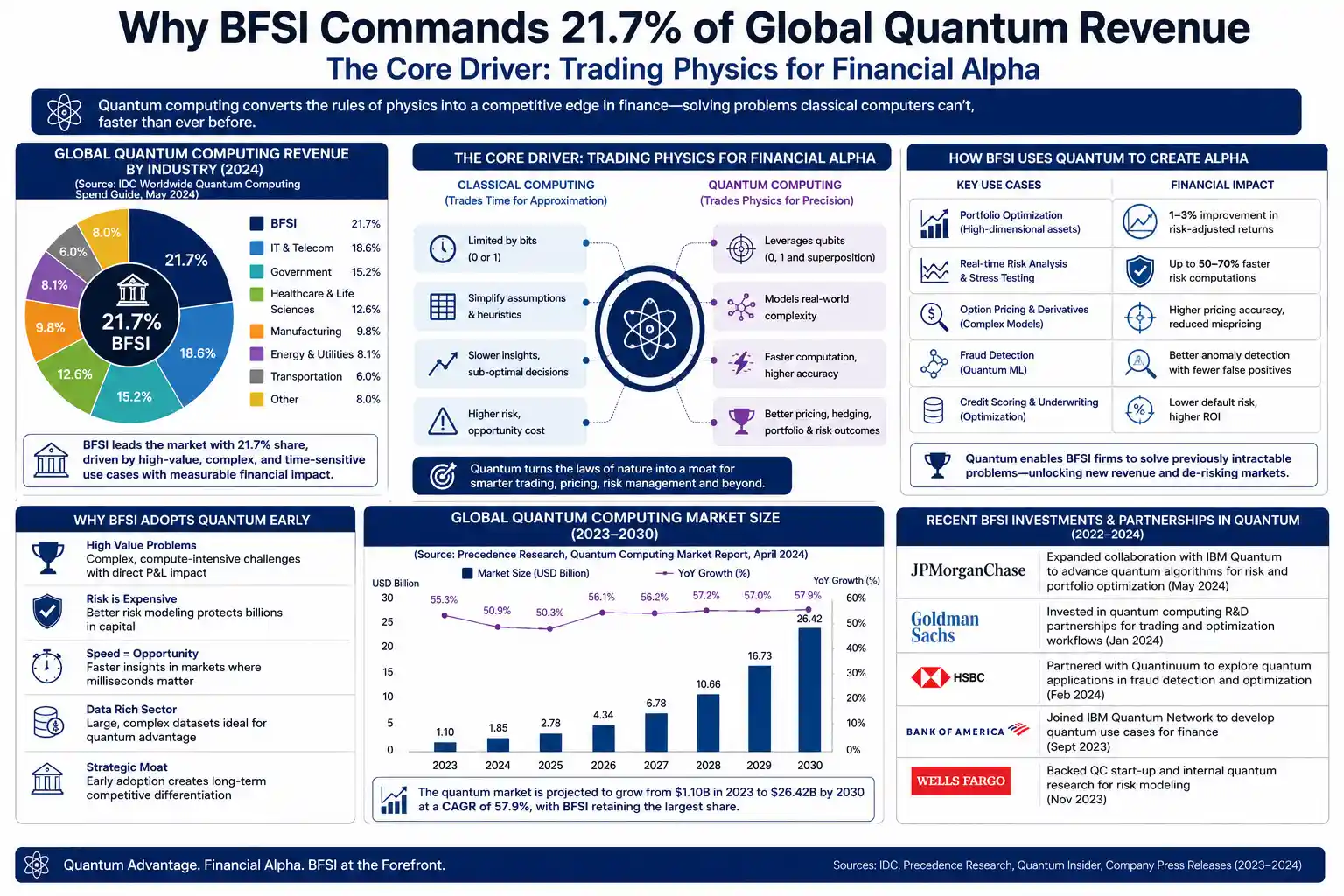
Financial institutions are investing heavily in quantum because it bypasses this bottleneck. They aren’t replacing their infrastructure. They are offloading the heaviest, most complex mathematical burdens to Quantum Processing Units (QPUs).
Portfolio Optimization and the Quantum Sharpe Ratio
Quantum portfolio optimization allows hedge funds to analyze millions of asset combinations simultaneously. By routing these combinatorial calculations to quantum annealers, financial firms can identify the precise asset mix that maximizes returns while minimizing risk, effectively achieving a superior Sharpe ratio faster than classical hardware allows.
Modern portfolio theory relies on finding the perfect balance of risk and reward. When a fund manager looks at a portfolio of 500 assets, there are more possible combinations than there are atoms in the observable universe.
Classical computers have to rely on approximations and heuristics to guess the best portfolio mix. They simply cannot check every path.
Quantum algorithms, specifically those running on quantum annealers, evaluate these massive landscapes simultaneously. By identifying the absolute mathematical minimums in an energy landscape, they map out the exact asset allocations that yield the highest potential Sharpe ratio. Capturing even a fraction of a basis point of optimization on a $100 billion portfolio justifies the cost of quantum cloud access instantly.
Crushing Monte Carlo Simulation Bottlenecks
Banks use Monte Carlo simulations to predict market risks by modeling thousands of variables. Quantum computing drastically accelerates these simulations using quantum amplitude estimation. This allows banks to price complex derivatives and calculate Value at Risk in near real-time, rather than running overnight batch processes.
If you walk onto the trading floor of any major investment bank, you will find classical servers grinding through overnight Monte Carlo simulations. These simulations inject random variables into pricing models to forecast how an asset will perform under extreme market stress.
The problem? They take hours. If a global geopolitical event happens at 2:00 PM, a bank cannot wait until 3:00 AM to understand its risk exposure.
Through algorithms like Quantum Amplitude Estimation (QAE), quantum computers achieve a quadratic speedup over classical systems. What takes a classical supercomputer 12 hours can theoretically be compressed into minutes. Banks are paying a premium to turn overnight risk analysis into intraday, real-time intelligence.
The Defensive Spending Spree: Post-Quantum Cryptography (PQC)
A massive portion of BFSI quantum spending is defensive. Financial institutions are investing heavily in Post-Quantum Cryptography (PQC) to protect against “Store Now, Decrypt Later” cyber attacks. Upgrading legacy encryption protocols ensures global financial clearinghouses and sensitive data remain secure against future quantum decryption capabilities.
Not all of the 21.7% market share is allocated to making money. A massive portion is allocated to preventing total systemic collapse.
Shor’s Algorithm is a quantum algorithm capable of factoring large prime numbers the mathematical foundation of RSA encryption. While fault-tolerant quantum computers capable of breaking banking encryption don’t exist yet, the threat is actively priced into banking budgets today.
Q-Day and the Threat to Financial Clearinghouses
Q-Day refers to the hypothetical point when quantum computers successfully break standard internet encryption. Financial institutions are preemptively upgrading to quantum-resistant ledgers and communication networks to secure trillions of dollars in daily transactions from state-sponsored actors harvesting encrypted data today.
Hackers currently utilize a “Store Now, Decrypt Later” strategy. They steal encrypted banking ledgers today, hoarding the data until quantum hardware matures enough to crack it.
To combat this, tier-one banks are aggressively funding the rollout of Post-Quantum Cryptography. They are integrating Quantum Key Distribution (QKD) to secure data transmission between global data centers. Protecting the clearinghouses that process trillions in daily derivatives is a non-negotiable IT expense, driving massive revenue to enterprise quantum security vendors.
The Architecture: Hybrid Quantum-Classical Workflows
Financial institutions do not use quantum computers as standalone machines. They deploy hybrid quantum-classical workflows, where classical servers handle data structuring and API routing, while the heavy algorithmic processing is outsourced to a cloud-based quantum processor, maximizing efficiency and integration with existing IT.
A common misconception is that banks are installing glowing quantum chandeliers in their basements. In reality, the deployment is entirely hybrid and cloud-based.
A modern quantitative trade workflow looks like this:
-
Classical servers ingest real-time market data from Bloomberg or Reuters.
-
Classical machine learning algorithms clean and structure the data.
-
The classical system identifies a highly complex optimization bottleneck.
-
The system makes an API call, offloading just that specific calculation to a cloud-based QPU (via AWS Braket or IBM Quantum).
-
The QPU returns the optimized variable back to the classical system to execute the trade.
This hybrid approach allows banks to leverage quantum advantages today without waiting for a fully fault-tolerant, standalone quantum ecosystem.
How Wall Street is Deploying Quantum Budgets in 2026
The BFSI sector is highly pragmatic. They are not funding science projects; they are demanding vendor-agnostic infrastructure.
Major banks utilize different quantum architectures for different problems. They may route optimization problems to D-Wave’s quantum annealers, while sending complex machine learning workloads to gate-based systems from Quantinuum or IBM.
The immediate barrier isn’t just hardware, it’s talent. A significant portion of that 21.7% revenue chunk is being spent on specialized middleware and consulting. Banks are paying aggressive premiums for quantitative developers who can translate financial pricing models into quantum circuits.
The Verdict: Why the 21.7% Market Share Will Grow
The BFSI sector’s grip on the quantum market is expanding. As hardware transitions from the Noisy Intermediate-Scale Quantum (NISQ) era into early fault tolerance, the financial use cases will move from R&D pilots into live production environments.
In finance, the first institution to gain a sustained technological edge effectively taxes the rest of the market. Wall Street knows that in the quantum era, being second means being obsolete. That dynamic guarantees the financial sector will remain the most lucrative client for quantum computing vendors for the next decade.