
How Defense Contractors Are Rebuilding Their Root of Trust for the CNSA 2.0 Mandate (2026 Deep Analysis)
National Security Systems operate on trust. That trust begins the millisecond a server powers on. If the initial boot sequence is compromised, every software security layer stacked above it is useless.
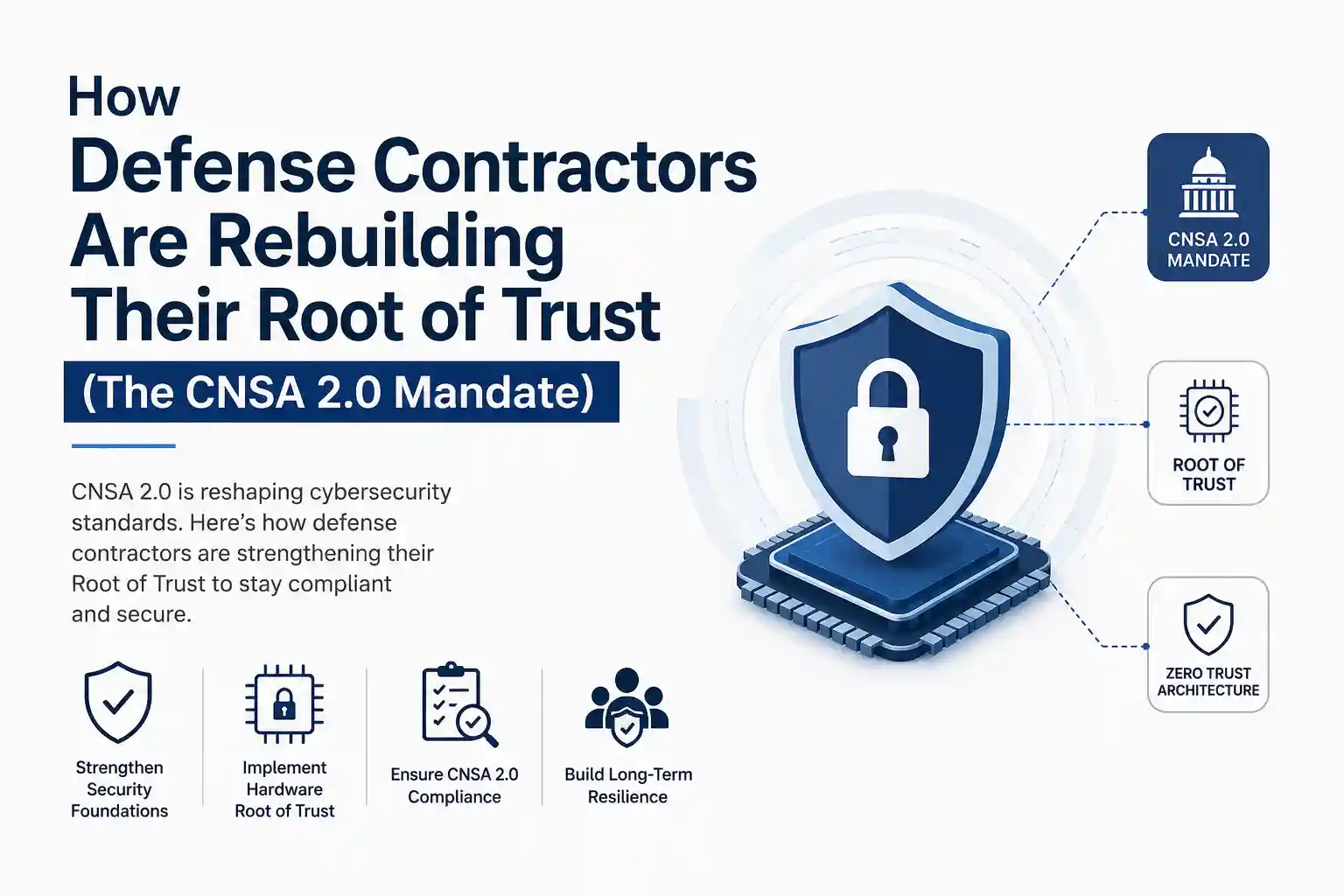
Defense contractors operate under a rigid, unyielding deadline. By 2030, the National Security Agency requires all National Security Systems (NSS) to transition to post-quantum cryptography (PQC). This mandate, defined as the Commercial National Security Algorithm Suite 2.0 (CNSA 2.0), forces the Defense Industrial Base to rip out decades of foundational encryption and rebuild their hardware and software roots of trust.
For decades, defense contractors relied on RSA and ECC algorithms to verify firmware signatures. The NSA’s Commercial National Security Algorithm Suite 2.0 (CNSA 2.0) abruptly ends that era. Quantum computers will eventually break legacy cryptography. To prevent catastrophic supply chain vulnerabilities, the NSA is forcing a massive transition to post-quantum cryptography (PQC).
This is not a software update. It requires physically rethinking how silicon validates code.
What the CNSA 2.0 Mandate Actually Changes
CNSA 2.0 is an NSA directive requiring all National Security Systems to transition to post-quantum cryptography. It specifies exact lattice-based and hash-based algorithms, completely replacing legacy RSA and ECC. By January 1, 2027, all newly acquired defense equipment must support these quantum-resistant standards.
Previous directives offered vague warnings about quantum threats. CNSA 2.0 delivers exact engineering constraints. It names the exact algorithms, specifies the parameter levels, and ties enforcement directly to procurement eligibility.
If you build hardware for the Department of Defense, your equipment must natively support PQC. You can no longer rely on commercial-off-the-shelf security controllers that default to classic ECC. Every component in a multi-board system must prove its integrity using mathematics that a quantum computer cannot solve.
Why Hardware Root of Trust Is the Primary Bottleneck
Hardware Root of Trust is the most critical bottleneck for CNSA 2.0 because silicon cannot be easily patched. If a device deploys with legacy cryptographic algorithms hardcoded into its secure boot process, it remains vulnerable for its entire physical lifespan.
When a device boots, the hardware Root of Trust verifies the digital signature of the first piece of code. This happens before the operating system loads.
Updating software to use a new encryption algorithm takes a few hours. Updating hardware requires designing new microcontrollers, changing board layouts, and managing supply chains for new silicon. Defense contractors are currently overhauling their platform firmware resiliency to align with NIST SP 800-193 guidelines using new, quantum-ready controllers.
The Threat of Firmware Lock-In
Firmware lock-in occurs when a hardware device is permanently restricted to the verification algorithm it shipped with. Integrating CNSA 2.0-compliant signatures early prevents defense contractors from deploying expensive hardware that becomes legally non-compliant or technically obsolete within a few years.
Many embedded systems operate in classified environments for 15 to 20 years. If you ship a radar system today with a bootloader that only understands RSA-3072, you are creating a massive liability.
You cannot simply push a quantum-resistant update later if the hardware itself refuses to recognize the new signature format. Engineering teams must build hybrid secure boot architectures today. These systems must support classical cryptography now, while containing the silicon necessary to validate post-quantum signatures tomorrow.
Approved Algorithms for Defense Hardware
CNSA 2.0 strictly limits approved hardware algorithms to specific high-security parameter sets. For firmware signing, it mandates LMS or XMSS hash-based signatures, or ML-DSA-87. Symmetric encryption requires AES-256 exclusively. Lower parameter sets are strictly prohibited for classified use.
The NSA did not approve everything NIST standardized. They selected only the highest security levels.
| Use Case | CNSA 2.0 Approved Algorithm | Deprecated Standard |
| Key Establishment | ML-KEM-1024 | ECDH, RSA Key Transport |
| Digital Signatures | ML-DSA-87 | ECDSA, RSA |
| Firmware Signing | LMS, XMSS, ML-DSA-87 | RSA, ECDSA |
| Hashing | SHA-384, SHA-512 | SHA-256 |
Notice the parameters. NIST standardized ML-KEM-512 for general commercial use, but the NSA explicitly rejects it for National Security Systems. You must use ML-KEM-1024.
LMS and XMSS for Firmware Signing
LMS and XMSS are stateful hash-based digital signature schemes prioritized by CNSA 2.0 for firmware validation. The NSA favors these algorithms because validated hardware implementations exist today, allowing defense contractors to secure their boot processes immediately without waiting for newer lattice-based standards.
LMS (Leighton-Micali Signatures) and XMSS (eXtended Merkle Signature Scheme) are mature. The math is well understood, and the hardware acceleration exists.
Using these for firmware signing is complex because they are “stateful.” The hardware must track exactly how many times a key has been used to sign data. If a state is reused, the security breaks entirely. Implementing this securely requires specialized non-volatile memory management within the root of trust controller.
The Post-Quantum Reality for the Defense Industrial Base

The Defense Industrial Base must adopt CNSA 2.0 because quantum computers running Shor’s algorithm will soon break RSA and Elliptic Curve Cryptography. This mandate requires contractors to replace vulnerable asymmetric encryption with quantum-resistant, lattice-based algorithms across all networks, software, and hardware involved in national security.
Legacy cryptographic standards rely on the mathematical difficulty of factoring large prime numbers. Quantum processing destroys this paradigm.
Why the NSA Replaced CNSA 1.0
The NSA replaced CNSA 1.0 with CNSA 2.0 to neutralize the specific threat of Cryptographically Relevant Quantum Computers (CRQC). CNSA 1.0 relied on AES-256 and ECC-384. CNSA 2.0 mandates lattice-based algorithms and hash-based signatures that remain mathematically secure against quantum decryption capabilities.
CNSA 1.0 was designed for a classical computing environment. It served as a stopgap, increasing key sizes (like mandating RSA-3072) to buy time. That time has expired.
The intelligence community operates on the premise that adversaries are executing “harvest now, decrypt later” campaigns. State-sponsored threat actors are actively scraping and storing encrypted IP, weapons schematics, and secure communications from defense contractors today. They intend to decrypt this data the moment a viable quantum machine comes online.
Rebuilding the root of trust stops this data hemorrhage. It ensures that data captured tomorrow cannot be broken a decade from now.
Mapping the CNSA 2.0 Timeline to Contractor Operations
The CNSA 2.0 timeline spans from 2025 to 2033. By 2025, software and firmware must support PQC by default. By 2030, all national security systems must exclusively use CNSA 2.0 algorithms. By 2033, all legacy cryptographic algorithms will be officially decertified for defense use.
Defense contractors cannot wait until 2029 to begin hardware procurement. The migration requires a phased rollout aligned with standard hardware refresh cycles.
2025: Software and Firmware Prioritization
By 2025, all newly acquired software, firmware, and operating systems utilized by defense contractors must default to CNSA 2.0-compliant algorithms. This immediate deadline targets code signing and secure boot processes before addressing deeper hardware encryption layers.
Software updates are the entry point. The NSA prioritizes firmware over-the-air (FOTA) updates and operating system signatures. If a contractor’s secure boot mechanism relies on RSA or ECC, the entire device is compromised at startup.
Engineering teams must audit their build pipelines immediately. Continuous Integration/Continuous Deployment (CI/CD) environments must swap legacy signature generation for stateful hash-based signatures.
2030-2033: The Hard Hardware Deadlines
Between 2030 and 2033, the DoD will enforce a strict ban on non-PQC hardware. All custom silicon, network infrastructure, and cryptographic modules must exclusively process FIPS-validated quantum-resistant algorithms. Legacy systems that cannot be upgraded must be physically decommissioned or isolated.
Hardware replacement is a capital expenditure nightmare. Aerospace and naval contractors deal with embedded systems boasting 20-year lifespans.
A drone deployed in 2024 using an embedded TPM 2.0 chip will likely lack the processing power and memory registers to handle the massive key sizes of lattice-based cryptography. These platforms require immediate engineering redesigns to decouple the cryptographic processing from the legacy microcontroller.
Deconstructing the New FIPS Post-Quantum Standards
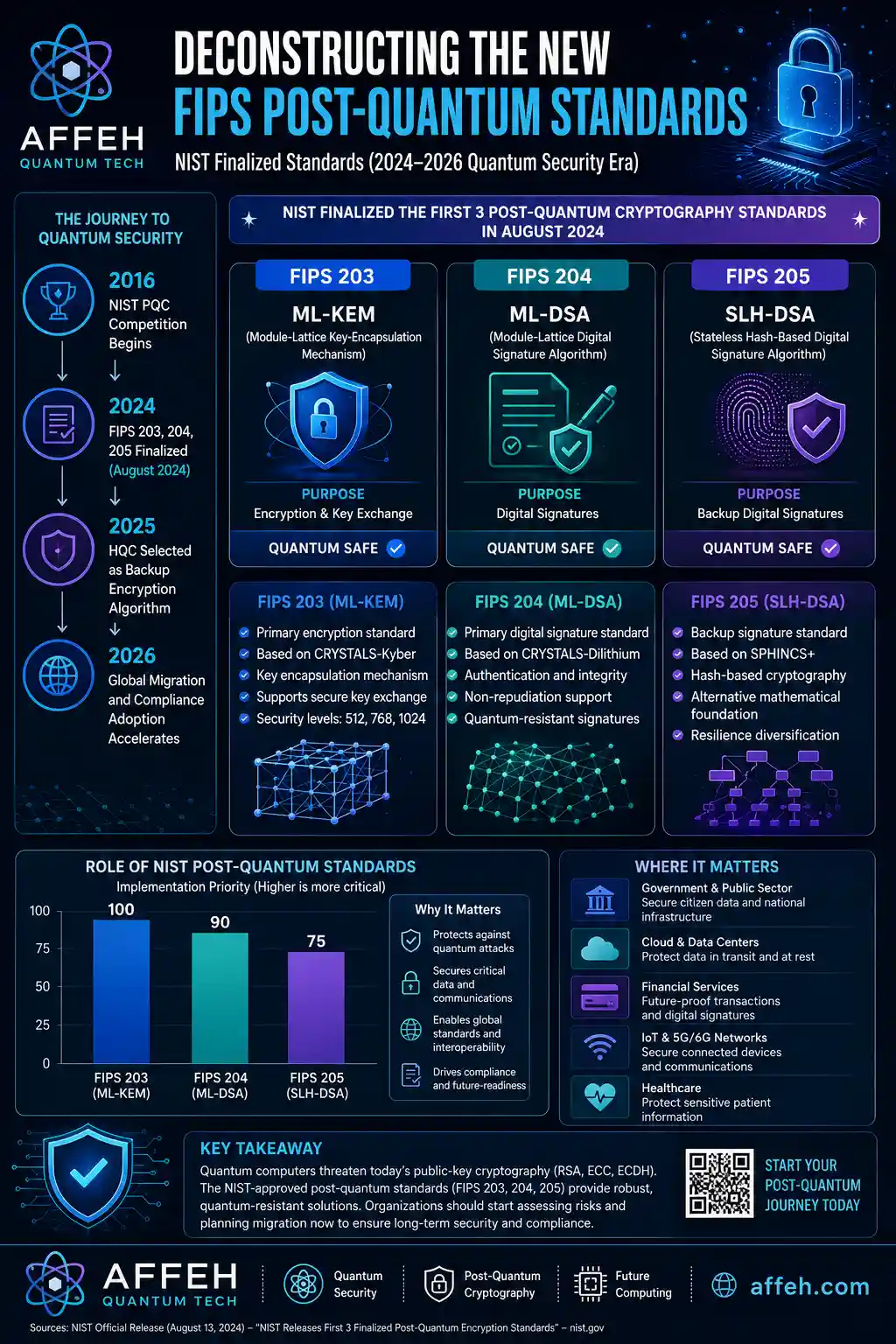
The National Institute of Standards and Technology (NIST) finalized three PQC standards in August 2024: FIPS 203 for key encapsulation, and FIPS 204 alongside FIPS 205 for digital signatures. Defense contractors must map their existing cryptographic functions directly to these specific Federal Information Processing Standards.
The NSA mandate explicitly ties compliance to these finalized NIST standards. Draft algorithms are no longer acceptable for production deployment.
FIPS 203 (ML-KEM) for Key Establishment
FIPS 203, known as Module-Lattice-Based Key Encapsulation Mechanism (ML-KEM), replaces RSA and Diffie-Hellman for secure key exchange. Defense contractors must implement ML-KEM to secure data-in-transit across VPNs, TLS connections, and secure communication channels handling controlled unclassified information.
ML-KEM operates on structured lattices. The primary engineering challenge is payload size. An ML-KEM public key is significantly larger than a traditional ECC key.
When network engineers implement ML-KEM over legacy VPN concentrators, the increased packet size often exceeds the standard Maximum Transmission Unit (MTU) of 1500 bytes. This causes packet fragmentation, increased latency, and firewall drops. Network architects must rewrite packet handling rules to accommodate these larger encapsulation mechanisms.
FIPS 204 (ML-DSA) and FIPS 205 (SLH-DSA) for Digital Signatures
FIPS 204 (ML-DSA) is the primary standard for general-purpose digital signatures, replacing ECDSA. FIPS 205 (SLH-DSA) serves as a fallback stateless hash-based signature. Contractors use these to authenticate identity, sign digital documents, and verify the integrity of transmitted data.
ML-DSA is fast but requires substantial memory overhead. SLH-DSA provides a mathematical backup—if researchers discover a flaw in lattice cryptography, the hash-based SLH-DSA remains secure.
Contractors building Public Key Infrastructure (PKI) systems must re-architect their Certificate Authorities (CAs). X.509 certificates will bloat in size. Systems hardcoded to expect small certificate chains will fail catastrophically during validation.
XMSS and LMS for Firmware Updates
XMSS (RFC 8391) and LMS (RFC 8554) are stateful hash-based signature schemes specifically mandated by CNSA 2.0 for firmware and software code signing. Defense contractors must use these algorithms to ensure secure boot processes and authorized software updates on deployed hardware.
Stateful signatures require meticulous state management. Every time a private key generates a signature, its internal state updates. If a system crashes and reuses a previous state, the entire private key is compromised.
Embedded systems engineers must design non-volatile memory architectures that guarantee state updates complete successfully before the signature is deployed, even during unexpected power failures in the field.
The Cryptography Bill of Materials (CBOM)
A Cryptography Bill of Materials (CBOM) is an inventory document detailing every cryptographic algorithm, library, key length, and certificate utilized within a software or hardware asset. Generating a CBOM is the mandatory first step for defense contractors executing a CNSA 2.0 migration.
You cannot replace what you cannot see. Most defense contractors suffer from cryptographic sprawl. Developers copy-paste OpenSSL code snippets, vendors embed proprietary encryption in compiled binaries, and legacy APIs hardcode MD5 hashes.
A CBOM maps this chaos. By 2026, expect the DoD to require CBOM submissions alongside traditional SBOMs during the procurement process.
Automated Cryptographic Discovery Methods
Automated cryptographic discovery involves scanning source code, network traffic, and file systems to locate encryption assets. Defense contractors utilize static application security testing (SAST) and dynamic analysis tools to map cryptographic calls and build an accurate, continuous CBOM.
Manual audits via spreadsheets fail immediately at enterprise scale.
Modern discovery tools integrate directly into the Git repository. They flag deprecated calls, like EVP_sha1() in OpenSSL, and block the pull request. Network-based discovery tools monitor TLS handshakes in real-time, identifying exactly which servers are still negotiating vulnerable RSA-1024 cipher suites.
Analyzing Compiled Binaries for Hardcoded Crypto
Discovering cryptography in compiled binaries requires reverse-engineering tools that analyze execution paths and memory registers without source code. Contractors must deploy binary analysis to uncover undocumented encryption buried inside third-party vendor applications and legacy weapon systems.
Third-party risk is massive. A prime contractor may build a compliant system, but a subcontractor’s supplied sensor module might rely on an embedded, hardcoded RSA key.
Security teams must use binary analysis to detect the distinct mathematical constants and looping structures indicative of cryptographic functions. If a vendor cannot provide a PQC upgrade path for a compiled binary, that vendor must be excised from the supply chain.
Engineering Cryptographic Agility
Cryptographic agility is the architectural design principle allowing organizations to swap out encryption algorithms rapidly without altering core application logic. Defense contractors must engineer agility to ensure future cryptographic migrations do not require multi-year software rewrites.
Hardcoding algorithms is a terminal architectural failure. The transition to CNSA 2.0 is difficult precisely because systems were not built to be agile.
Abstraction Layers over Direct API Calls
Contractors achieve cryptographic agility by implementing abstraction layers. Instead of applications directly calling specific encryption algorithms, they query a centralized cryptographic provider. This allows security teams to update algorithms universally by modifying the provider, rather than rewriting application code.
Consider a legacy application written in C++. If the developer explicitly called RSA_generate_key(), migrating to PQC requires a complete code rewrite, recompilation, and QA cycle.
In an agile architecture, the application calls a generic function like Generate_Secure_Key(). The underlying provider (often a modernized HSM or centralized key management server) determines whether to serve an ECC key or an ML-KEM key based on central policy.
Implementing NSA-Approved Hybrid Cryptography
Hybrid cryptography combines a classical algorithm (like ECC) with a post-quantum algorithm (like ML-KEM) to secure a single connection. The NSA approves this bridging strategy for defense contractors transitioning to CNSA 2.0, ensuring security even if the new PQC algorithms contain undiscovered flaws.
The NSA actively encourages hybrid deployments during the transition window.
In a hybrid TLS 1.3 handshake, the client and server negotiate two separate secrets—one using classical elliptic curves and one using lattice-based PQC. These secrets are concatenated. An adversary must break both the classical math and the quantum math simultaneously to decrypt the traffic. This provides a safety net while the industry stress-tests the new FIPS algorithms in production environments.
Upgrading the Hardware Root of Trust
Upgrading the hardware root of trust requires physically replacing legacy cryptographic processors with modules capable of generating and storing massive PQC keys. Defense contractors must evaluate and deploy next-generation HSMs and TPMs to secure the physical foundation of their networks.
Software encryption is meaningless if the hardware generating the random numbers is compromised.
HSM and TPM Lifecycle Limitations
Hardware Security Modules (HSMs) and Trusted Platform Modules (TPMs) possess strict physical limitations regarding memory and processing speed. Legacy modules cannot accommodate the processing overhead of FIPS 204 signatures, forcing defense contractors to procure modern hardware.
A standard TPM 2.0 chip contains limited non-volatile RAM (NVRAM). Storing an ML-DSA private key, which can exceed 4,000 bytes, simply will not fit in the existing silicon architecture.
Contractors must audit their HSM fleet. Upgrading often requires more than a firmware flash; it requires forklift upgrades of data center appliances. Procurement officers must demand explicit PQC hardware roadmaps from vendors like Thales, Entrust, and Utimaco before signing renewal contracts.
The Real Deadline: January 2027
The critical deadline for defense contractors is January 1, 2027. Starting on this date, all new acquisitions for National Security Systems must natively support CNSA 2.0 algorithms. Products failing to meet this standard will be ineligible for deployment in classified environments.
Do not look at the 2035 “full transition” date cited by politicians. Look at the procurement rules.
The transition phase is happening right now. By late 2026, defense procurement officers will demand proof of PQC support in your bill of materials. If your hardware relies on outdated security modules, your bids will be rejected.
Execution Plan for Crypto-Agility
Transitioning hardware requires a methodical approach to crypto-agility.
The defense industry cannot wait for quantum computers to mature before taking action. The hardware supply chain moves slowly, and the legal mandates are moving fast. Securing the root of trust today is the only way to ensure market access tomorrow.