
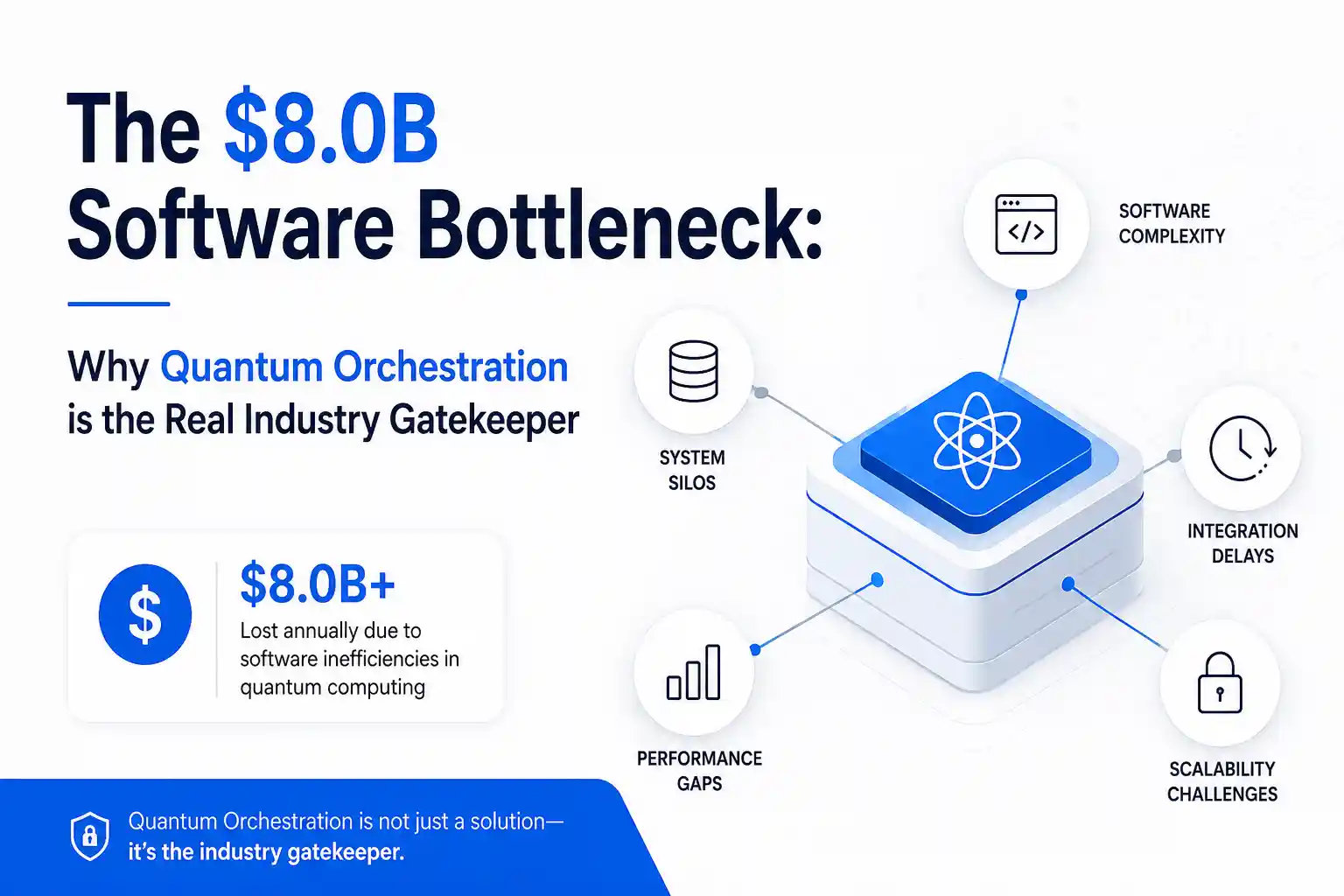
The $8.0B Software Bottleneck: Why Quantum Orchestration is the Real Industry Gatekeeper
The tech industry is hyper-fixated on hardware. Every quarter, a new press release announces a larger quantum processor, boasting higher qubit counts and longer coherence times. But enterprise adoption is stalling. The reason isn’t the hardware. It’s the software.
Specifically, the failure to smoothly integrate quantum processing units (QPUs) with classical data centers has created an $8.0 billion roadblock. This layer quantum orchestration is the true gatekeeper of the next computing era.
The Hardware Delusion: Why Qubits Aren’t Enough
Quantum hardware scaling is insufficient for enterprise use without quantum orchestration software. Bare-metal QPUs cannot independently manage complex data pipelines. They require orchestration software to divide tasks, route classical compute to GPUs, and send only specific, optimized math to the quantum processor in real-time.
Building a 10,000-qubit machine is a monumental physics achievement. In isolation, however, it is commercially useless. Quantum computers do not run entire applications. They function as highly specialized accelerators, much like early GPUs.
If a financial institution wants to run a portfolio optimization model, 95% of that workload remains on classical servers. The quantum computer only handles the specific combinatorial optimization step. Orchestration software must split the code, send the classical math to a CPU, format the quantum math for the QPU, and stitch the results back together.
The Hybrid Workflow Latency Trap
The hybrid workflow latency trap occurs when the data transfer speed between classical servers and quantum processors is slower than the computation itself. Without optimized orchestration middleware, this latency bottlenecks hybrid quantum algorithms, rendering quantum speedups entirely useless in real-world enterprise applications.
Current quantum algorithms, like Variational Quantum Eigensolvers (VQEs), require thousands of back-and-forth loops between classical and quantum hardware. Suppose your orchestration layer introduces a 50-millisecond delay transferring data between a cloud GPU and an on-premise QPU; the execution time balloons. The “quantum advantage” evaporates instantly.
What is Quantum Orchestration?
Quantum orchestration is the middleware layer that manages workloads across classical CPUs, GPUs, and quantum QPUs. It compiles code, optimizes algorithms for specific quantum hardware, manages job queuing, mitigates errors, and translates outputs back into classical data formats for enterprise applications.
Orchestration is the traffic controller. It sits between your enterprise application and the physical quantum hardware. Without it, developers must manually write low-level machine code tailored to the specific physics of individual quantum machines—an impossible barrier to scale.
The Three Layers of Quantum Middleware
Understanding orchestration requires breaking it down into its functional stack.
| Middleware Layer | Function | Why It Matters |
| Workflow Routing | Distributes workloads between CPU, GPU, and QPU. | Prevents expensive QPUs from doing basic classical math. |
| Hardware Abstraction | Translates high-level Python into QPU-specific pulses. | Allows developers to write code once and run it on any hardware. |
| Error Mitigation | Filters out hardware noise from the final results. | Makes current, noisy quantum computers actually usable. |
Why the Market Values this Bottleneck at $8.0 Billion
The quantum orchestration market is valued at $8.0 billion because it represents the critical middleware lock-in. Enterprises are investing heavily in orchestration platforms to ensure hardware agnosticism, allowing them to switch between quantum hardware vendors without rewriting their entire software codebase.
Hardware will eventually become a commodity. In ten years, enterprise buyers won’t care if they are using superconducting qubits or trapped ions, just as modern cloud users rarely check whether they are running on Intel or AMD chips.
The value accrues at the abstraction layer. The companies building the orchestration software, like NVIDIA with CUDA-Q, or pure-play startups like Classiq and Zapata, are building the operating systems of the future. By locking developers into their software ecosystems, they capture the bulk of the market’s value.
Vendor Lock-in vs. Hardware Agnosticism
If an enterprise writes its entire chemistry pipeline natively in IBM’s Qiskit, switching to an IonQ or Quantinuum machine later requires a massive rewrite. Orchestration platforms solve this by offering hardware agnosticism. You code in a unified language; the orchestration layer compiles it for whoever offers the cheapest or fastest compute that day.
Case Studies: Orchestration in Enterprise Environments
Enterprise orchestration is already live. Automotive companies use hybrid middleware to route fluid dynamics to GPUs and material simulations to QPUs. Pharmaceutical firms rely on orchestration software to manage molecular docking simulations across distributed classical-quantum cloud environments, reducing compute times significantly.
Pharmaceuticals: Bridging CPUs, GPUs, and QPUs
Consider a 2026 drug discovery pipeline. The process requires screening millions of molecules.
-
Classical CPUs query the chemical database.
-
GPUs run the initial AI-driven filtering.
-
The QPU calculates the precise binding energy of the top 10 candidates.
The orchestration layer handles this automatically. If a company tries to hard-code this pipeline without middleware, a single hardware update from their QPU provider will break their entire multi-million-dollar R&D process.
The Core Mechanics of a Quantum Orchestration Platform (QOP)
A Quantum Orchestration Platform (QOP) operates via three core mechanics: dynamic pulse generation for hardware translation, ultra-low latency feedback loops for real-time error correction, and seamless hybrid integration between classical servers and quantum processing units within a unified compute environment.
To understand why traditional software fails here, we have to look at the mechanics of a dedicated QOP. A modern orchestration architecture replaces fragmented lab instruments with a cohesive hardware-software stack.
Pulse Generation and Hardware Translation
Pulse generation is the process of converting algorithmic commands into analog physical signals, such as lasers or microwaves. A QOP must generate these precise electromagnetic pulses instantly to manipulate qubit states without introducing latency that leads to quantum decoherence.
Qubits lose their quantum state rapidly, a process called decoherence. A QOP must compile code, generate the necessary microwave or laser pulse, and send it down the coaxial cable into the dilution refrigerator before the qubit loses its memory. This requires nanosecond precision. Traditional operating systems simply cannot process tasks fast enough to meet this strict physical deadline.
Real-Time Error Correction and Feedback Loops
Real-time error correction uses classical processors to detect qubit errors during an operation and apply corrective pulses instantly. Because qubits are highly unstable, this feedback loop must execute within nanoseconds to preserve the computation before the quantum state collapses entirely.
In classical computing, error correction happens after the fact or via redundancy. In quantum computing, you have to fix the airplane while it is flying. If a qubit begins to drift, the QOP must read the error, calculate the fix, and send a corrective pulse while the algorithmic sequence is still running.
Hybrid Quantum-Classical Integration
Hybrid integration is the seamless pairing of classical computing servers with quantum processors. A QOP orchestrates this by delegating complex mathematical heavy lifting to the QPU while keeping standard data processing, logic gating, and memory storage on traditional high-performance classical servers.
Quantum computers will never run your email servers or CRM software. The future is hybrid. A proper orchestration platform acts as a smart router. It looks at an enterprise workload, sends the optimization problem to the QPU, keeps the data management on an NVIDIA GPU, and syncs the results flawlessly.
The Cost of Ignoring the Middleware Layer
Ignoring the quantum middleware layer results in massive latency, severe qubit decoherence, and vendor lock-in. Without scalable orchestration, enterprises face diminishing returns on hardware investments, as the classical control systems become the limiting factor for computational speed, accuracy, and commercial viability.
Companies rushing to buy quantum time on the cloud often overlook the orchestration layer. They run their algorithms and are disappointed by the error rates.
Here is the practical reality: if your control system introduces a 200-nanosecond delay in a system where qubits only survive for 100 microseconds, you are burning a significant percentage of your compute window just waiting for instructions.
-
The Hardware Trap: Buying a 1,000-qubit machine with a rigid, slow control system yields worse results than a 100-qubit machine with nanosecond orchestration.
-
The Lock-in Risk: Proprietary control software limits you to one hardware vendor. Hardware-agnostic orchestration allows you to swap a superconducting QPU for a trapped-ion QPU without rewriting your entire software stack.
How CIOs Should Navigate the Orchestration Gatekeeper
CIOs should adopt a software-first quantum strategy. Rather than buying quantum hardware, IT leaders must invest in hardware-agnostic orchestration platforms. This ensures future-proof workflows, prevents vendor lock-in, and allows teams to develop quantum-ready applications on classical simulators today.
The biggest mistake tech leaders make is focusing procurement on hardware specs. The smarter play is securing the software infrastructure that will make that hardware usable.
The Quantum-Ready Infrastructure Checklist
If you are building a quantum strategy this year, enforce these constraints:
Mandate hardware agnosticism: Never approve a software stack that only compiles to one specific QPU architecture.
Test the classical fallback: Ensure your orchestration layer can seamlessly route quantum tasks to classical GPU simulators when QPUs are offline or cost-prohibitive.
Audit latency tolerances: Map out the physical and network distance between your classical data lakes and your quantum compute providers to prevent the hybrid latency trap.
Focus on algorithmic integration: Hire integration engineers, not just quantum physicists. The bottleneck is IT networking, not quantum mechanics.
Quantum computing will revolutionize the enterprise. But the companies that win won’t be the ones that build the best qubits. They will be the ones who master the orchestration layer connecting those qubits to the rest of the world.