
The $12.6B Shift: Why Savvy VCs Are Pivoting From NISQ Startups to Fault-Tolerance
Venture capital thrives on calculated risks, but it rarely forgives a flawed premise.
For the last five years, billions have been poured into Noisy Intermediate-Scale Quantum (NISQ) computers. The pitch was simple: we don’t need perfect quantum computers; we just need ones “good enough” to outpace classical supercomputers.
That pitch is officially dead.
Over the last 18 months, $12.6 billion in deep tech venture capital has quietly migrated. It left the short-term promises of NISQ startups and locked into the long-term, structurally sound reality of Fault-Tolerant Quantum Computing (FTQC).
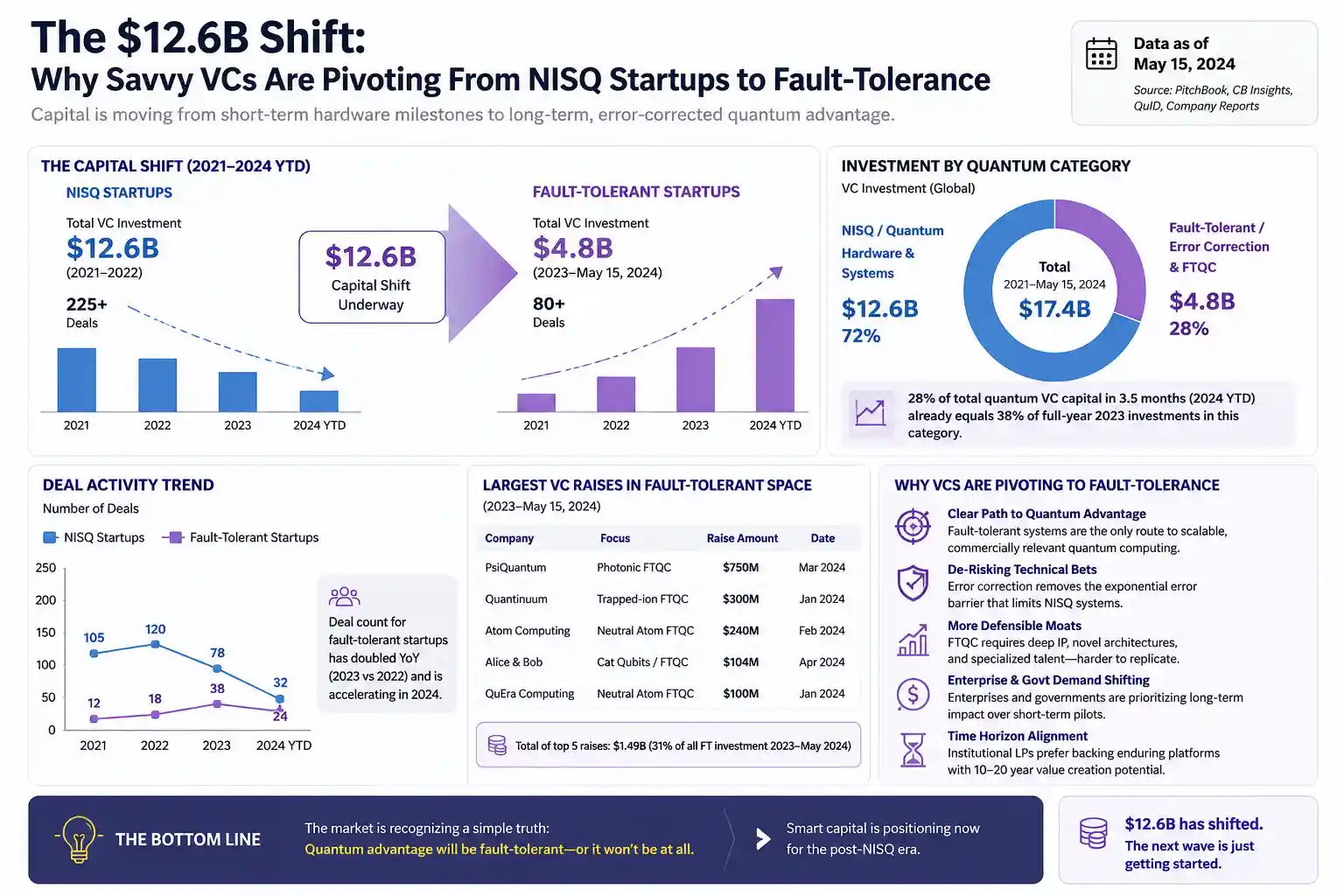
This isn’t a quantum winter. It’s a violent market correction. Here is exactly why the smartest money in Silicon Valley changed its mind.
What Triggered the $12.6B Capital Flight in Quantum?
The $12.6 billion VC shift from NISQ to fault-tolerant quantum computing occurred because noisy quantum computers failed to achieve commercial advantage over classical algorithms. Investors realized that without error correction, quantum noise compounds fatally. Capital consequently consolidated into startups building logical qubits and scalable error-correction architectures.
The shift didn’t happen because investors lost patience. It happened because classical computing fought back.
NISQ systems are inherently error-prone. To extract useful answers, early startups assumed they could run short, shallow quantum algorithms before the hardware’s “noise” destroyed the data.
But while quantum hardware struggled to scale without errors, classical AI and tensor networks improved exponentially. By late 2025, classical supercomputers easily simulated the complex chemistry and logistics problems that NISQ systems were supposed to dominate.
NISQ lost its commercial moat. The $12.6B reallocation was a direct response to this realization: without error correction, a quantum computer is just an expensive science experiment.
NISQ vs. Fault-Tolerance: The Investor’s Framework
For investors, NISQ represents high-risk, uncorrected physical qubits with no proven path to commercial supremacy. Fault-Tolerance (FTQC) represents stable, error-corrected logical qubits capable of sustained computation. VCs now view fault-tolerance as an engineering scaling problem, whereas scaling NISQ remains an unsolvable physics barrier.
Founders used to pitch raw physical qubit counts. “We have 400 qubits, our competitor has 100.”
Today, pitching physical qubits will get you laughed out of Sand Hill Road.
The industry standard is now the Logical Qubit. A logical qubit is a stable piece of information created by networking dozens or hundreds of noisy physical qubits together to correct each other’s errors.
Here is how venture capitalists evaluate the divide today:
| Metric | NISQ Startups | Fault-Tolerant Startups |
| Core Metric | Physical Qubit Count | Logical Qubit Fidelity |
| Investment Risk | Fundamental Physics | Systems Engineering |
| Commercial Moat | Evaporating (Classical AI wins) | Absolute (Unbreakable advantage) |
| Exit Horizon | 2-3 years (Failed) | 7-10 years (Realistic) |
The “Useful” Qubit Fallacy
The “useful qubit fallacy” was the mistaken belief that simply adding more noisy physical qubits would eventually yield commercial value. In reality, adding physical qubits without error correction increases system noise exponentially, making calculations useless. Investors now require fault-tolerant logical qubits for funding consideration.
If you have a leaking bucket, adding more water doesn’t solve the problem. You need to plug the hole.
NISQ startups tried to add more qubits without plugging the error rates. Fault-tolerant startups spend all their capital plugging the hole through quantum error correction (QEC). Once the hole is plugged, scaling becomes a predictable manufacturing challenge.
The VC Math: Why Logical Qubits Command Premium Valuations
VCs assign premium valuations to fault-tolerant quantum startups because logical qubits reduce technical execution risk. Once a startup demonstrates one stable logical qubit, scaling to hundreds becomes a predictable capital expenditure rather than a physics gamble, perfectly aligning with late-stage venture capital risk models.
To understand the $12.6B shift, you have to look at the structure of a standard venture fund.
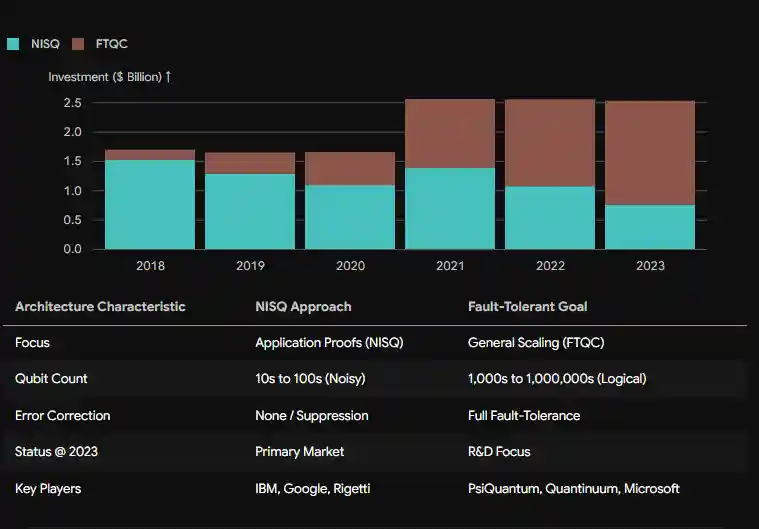
Deep tech funds usually run on a 10-to-12-year lifecycle. Early in the NISQ boom, VCs backed noisy systems hoping for a quick 4-year exit via an acquisition by Google or IBM.
When those acquisitions dried up, VCs faced a hard truth. They had to underwrite the technology all the way to commercial revenue.
The 10-Year Fund Lifecycle Dilemma
Deep tech venture funds operate on 10-year timelines. VCs abandoned NISQ because it failed to generate revenue within this window. Conversely, funding fault-tolerant architecture aligns perfectly with early-stage risk deployment, allowing funds to back structural engineering milestones that drive massive valuations by year seven.
Backing FTQC means accepting a longer timeline to a working product. However, it completely changes the risk profile.
If a startup proves it can build one perfect, fault-tolerant logical qubit, the physics risk drops to zero. The remaining challenge is pure systems engineering: cooling, cabling, and software control. VCs love engineering risks because they can be solved linearly with cash. They hate physics risks because no amount of money can rewrite the laws of thermodynamics.
Real-World Case Studies: The 2026 Investment Realignment
In 2026, quantum capital realignment heavily favored companies demonstrating error correction. Startups relying on raw physical qubit counts faced brutal down rounds. Meanwhile, companies integrating neutral atoms and topological error correction secured mega-rounds, proving VCs now fund architectural stability over raw hardware scale.
Look at the term sheets signed over the last four quarters.
The Casualties: Companies building pure superconducting NISQ chips without a clear error-correction roadmap faced massive down-rounds. Several pivoted quietly into quantum-inspired classical software just to survive.
The Winners: Startups utilizing neutral atom arrays or photonic systems that naturally lend themselves to error correction absorbed the bulk of the $12.6B.
When a major player demonstrated the entanglement of 50 stable logical qubits with lower error rates than the underlying physical hardware, it triggered a feeding frenzy. That milestone proved the mathematical theory of fault-tolerance was physically manufacturable.
How to Position Your Deep Tech Portfolio Now
To position a deep tech portfolio for the fault-tolerant quantum shift, investors must liquidate pure NISQ hardware holdings and reallocate capital into error correction software, control systems, and fault-tolerant architectures. Founders must rewrite their roadmaps to prioritize logical qubit fidelity over near-term commercial illusions.
If you are a founder or an allocator, holding onto the NISQ narrative is financial suicide. The market has moved.
You need to ruthlessly audit your current holdings or roadmap. Are you building technology that assumes a noisy system will somehow become commercially viable? Or are you building the picks and shovels for a fault-tolerant future?
The FTQC Pivot Checklist
The FTQC pivot checklist requires founders to prioritize error correction thresholds, replace physical qubit metrics with logical error rates, and align their software stack with fault-tolerant hardware. Startups must demonstrate how their technology bridges the gap between noisy components and error-corrected quantum computation.
If you are seeking capital in the current environment, your strategy must reflect the new reality:
-
Kill the “Near-Term” Slide: Remove any claims of achieving commercial advantage with noisy qubits. VCs know it’s a lie.
-
Highlight the Hardware-Software Co-design: Show how your stack specifically enables or accelerates quantum error correction.
-
Focus on Component Value: If you can’t build a full FTQC system, build the critical bottlenecks. Cryogenic control chips, laser modulation for neutral atoms, and QEC decoding algorithms are highly fundable right now.
-
Adopt the Logical Qubit Standard: Benchmark all your progress against logical error rates.
The $12.6B shift is not a retraction of faith in quantum computing. It is the maturation of the industry. The smart money finally realized that to build the future, you have to build it without errors.