
Qubit Count is Dead: Why CTOs Are Moving to Algorithmic Qubits (AQ) as the New Procurement Standard in 2026
Enterprise boards are demanding quantum strategies, but CTOs face a dangerous market trap. For the past five years, quantum hardware vendors sold the market on a flawed metric: raw physical qubit counts.
Buying a quantum computer based on physical qubits is like buying an enterprise server based purely on the number of transistors, completely ignoring clock speed, architecture, and thermal throttling. Raw qubits are noisy, fragile, and practically useless for enterprise algorithms.
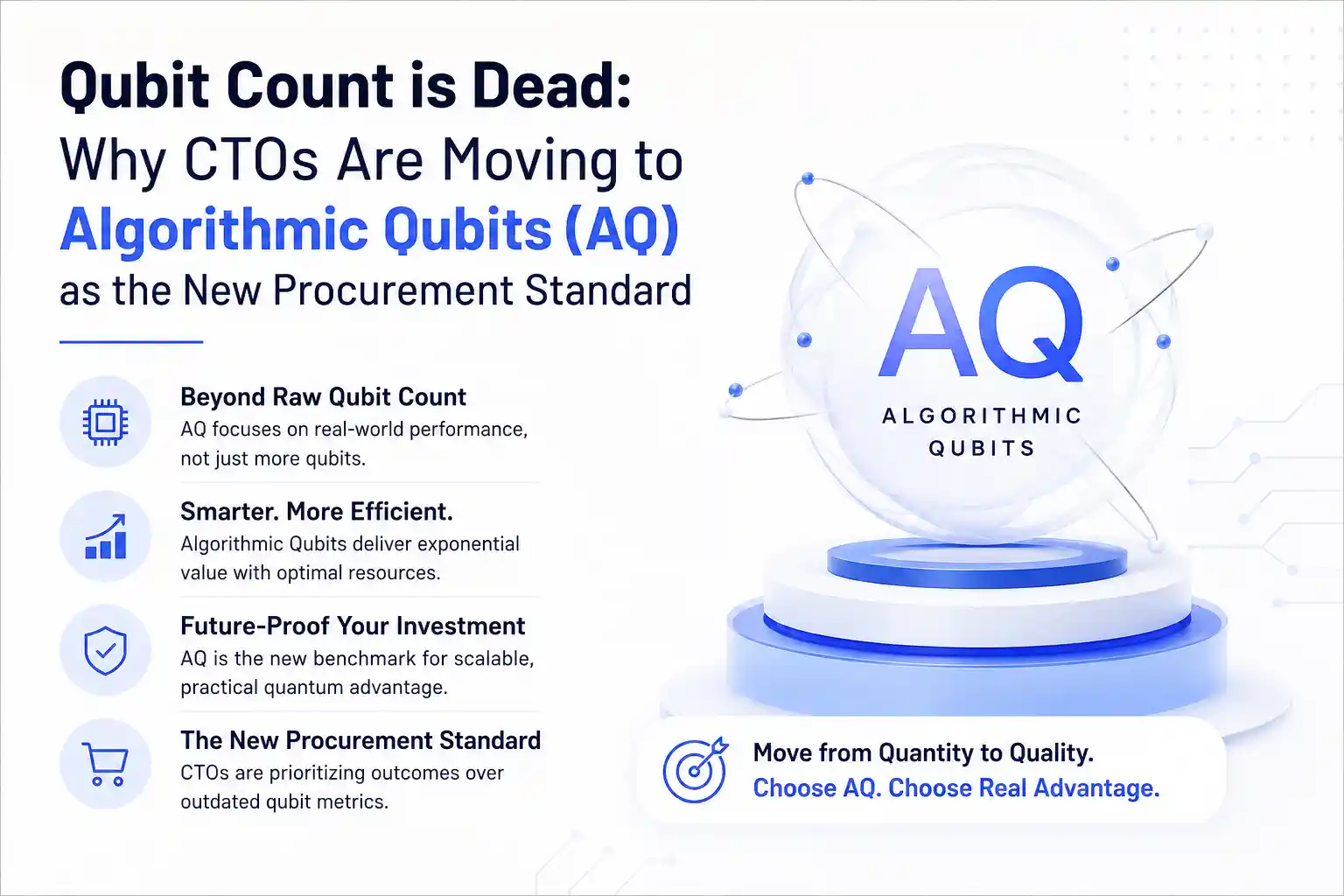
In 2026, the paradigm has shifted. Smart procurement teams have abandoned physical counts. The new standard for vendor evaluation and RFP generation is the Algorithmic Qubit (AQ).
The Physical Qubit Trap: A CTO’s Liability
Physical qubits are highly susceptible to environmental noise, leading to high error rates that destroy complex calculations. For CTOs, purchasing hardware based on physical qubit counts is a liability because, without massive error correction, these systems cannot run the deep circuits required for enterprise-grade algorithms.
Vendors love touting machines with 1,000, 5,000, or even 10,000 physical qubits. It looks great in a press release. But in the server room, it is a mathematical illusion.
Physical qubits suffer from decoherence. The moment you attempt to run a complex algorithm, the background noise corrupts the data. To fix this, hardware providers use Quantum Error Correction (QEC).
Depending on the underlying technology, whether superconducting circuits or neutral atoms, it can take anywhere from 10 to 1,000 physical qubits just to create one stable, reliable “logical” qubit. If a vendor sells you a 1,000-qubit machine, but their error correction requires a 100:1 ratio, you actually only have 10 useful qubits. That is an enterprise procurement disaster.
What Are Algorithmic Qubits (AQ)?
Algorithmic Qubits (AQ) measure the actual utility of a quantum computer. AQ represents the maximum number of high-fidelity qubits available to successfully run a quantum circuit without the calculation being destroyed by errors. It dictates the actual size of the algorithm an enterprise can execute.
AQ strips away the marketing fluff. Pioneered initially by hardware makers like IonQ but now widely adopted as a benchmark standard, AQ tells a CTO exactly what they are buying: computational depth.

If a system is rated at AQ 36, it means the hardware can successfully execute a quantum circuit involving 36 qubits and roughly 1,296 ($36^2$) quantum gates.
This metric incorporates everything that actually matters: gate fidelity, crosstalk, and coherence time. It translates quantum physics into a reliable software engineering constraint.
Physical Qubits vs. Quantum Volume vs. AQ
Physical qubits measure raw hardware parts. Quantum Volume (QV) is an older IBM metric measuring overall system capability, but scales exponentially, making it confusing for procurement. Algorithmic Qubits (AQ) scale linearly and directly correlate to the number of variables an enterprise algorithm can process.
Here is how enterprise architects currently evaluate these metrics in vendor pitches:
| Metric | What It Measures | Procurement Value | The CTO Reality |
| Physical Qubits | Raw individual quantum bits. | Zero. | High numbers hide terrible error rates. Ignore this in RFPs. |
| Quantum Volume | System-wide capability (IBM). | Low. | Scales exponentially (e.g., QV $2^{10}$). Confusing for finance teams to audit. |
| AQ (Algorithmic Qubits) | Usable algorithmic capacity. | Very High. | Direct line of sight to algorithm deployment. AQ 64 means you can run a 64-variable problem. |
The Economics of Error Correction in 2026
In 2026, quantum computing is a capital expenditure judged by the cost per Algorithmic Qubit. Systems requiring massive physical qubit overhead for error correction have higher cooling, power, and maintenance costs, destroying enterprise ROI compared to high-fidelity, natively stable hardware.
When a CTO drafts an RFP, they must calculate the Total Cost of Ownership (TCO). Physical qubits require extensive infrastructure. Superconducting systems, for example, require cryogenic cooling to near absolute zero.
If your vendor requires 10,000 physical qubits to yield an AQ of 50, you are paying the power, cooling, and maintenance costs for 9,950 “babysitter” qubits that do nothing but correct the errors of the 50 working ones.
Trapped ion and neutral atom modalities currently boast better native fidelities. They require far less physical overhead to achieve the same AQ, fundamentally altering the CapEx requirements for enterprise data centers.
How to Write a Quantum RFP Around AQ

A modern quantum RFP must demand proof of two-qubit gate fidelities exceeding 99.9% and mandate Algorithmic Qubit (AQ) benchmarks over physical counts. CTOs should require vendors to demonstrate algorithm execution on industry-standard circuits, completely separating hardware scale from actual computational utility.
Stop letting vendors dictate the terms of the conversation. If your procurement document asks for “number of qubits,” you are setting your organization up for failure.
The 5-Point Vendor Interrogation Framework
When engaging IBM, IonQ, Quantinuum, or emerging players, mandate these parameters in your next procurement cycle:
Demand AQ over Physical: Require vendors to state their precise Algorithmic Qubit count using independent verification tools (like the DARPA quantum benchmarking suite).
Audit the Two-Qubit Gate Fidelity: If a vendor’s two-qubit gate fidelity is below 99.9%, their physical qubits are practically worthless for deep circuits. Demand the raw fidelity data.
Calculate the Overhead Ratio: Ask explicitly: “How many physical qubits are required in your architecture to produce one logical qubit?”
Ignore Theoretical Roadmaps: Vendors sell on 2030 roadmaps. Buy in 2026 realities. Ask for live demonstrations of an algorithmic depth equal to their claimed AQ.
Require Hardware Abstraction: Ensure your quantum software stack (e.g., Qiskit, TKET) can run on their system without vendor lock-in.
The 2026 Vendor Reality Check
The 2026 quantum vendor landscape is split. Legacy providers emphasize massive physical scale but battle high error rates, while newer modalities like trapped ion and neutral atoms focus on high-fidelity Algorithmic Qubits (AQ), offering more immediate enterprise utility despite smaller physical footprints.
The market has matured. We are no longer in the era of buying science experiments. Enterprise quantum computing is about solving logistics, material science, and financial modeling problems that classical supercomputers cannot.
If a problem requires 64 variables entangled simultaneously, you need a system with an AQ of 64. It does not matter if the machine has 100 physical qubits or 100,000.
By shifting the procurement standard to Algorithmic Qubits, CTOs protect their budgets, mitigate hardware risk, and align quantum investments with actual software deliverables. The era of the qubit count is dead. The era of quantum utility is here.