

IBM’s 2029 Fault-Tolerant Roadmap: What It Means for Legacy Algorithmic Trading Today
The quantitative finance sector is currently misjudging the timeline of quantum computing. Many hedge funds still view quantum advantage as a post-2035 hypothetical. But IBM’s aggressive push toward fault-tolerant quantum computing (FTQC) by 2029 changes the math entirely for anyone running legacy algorithmic trading systems.
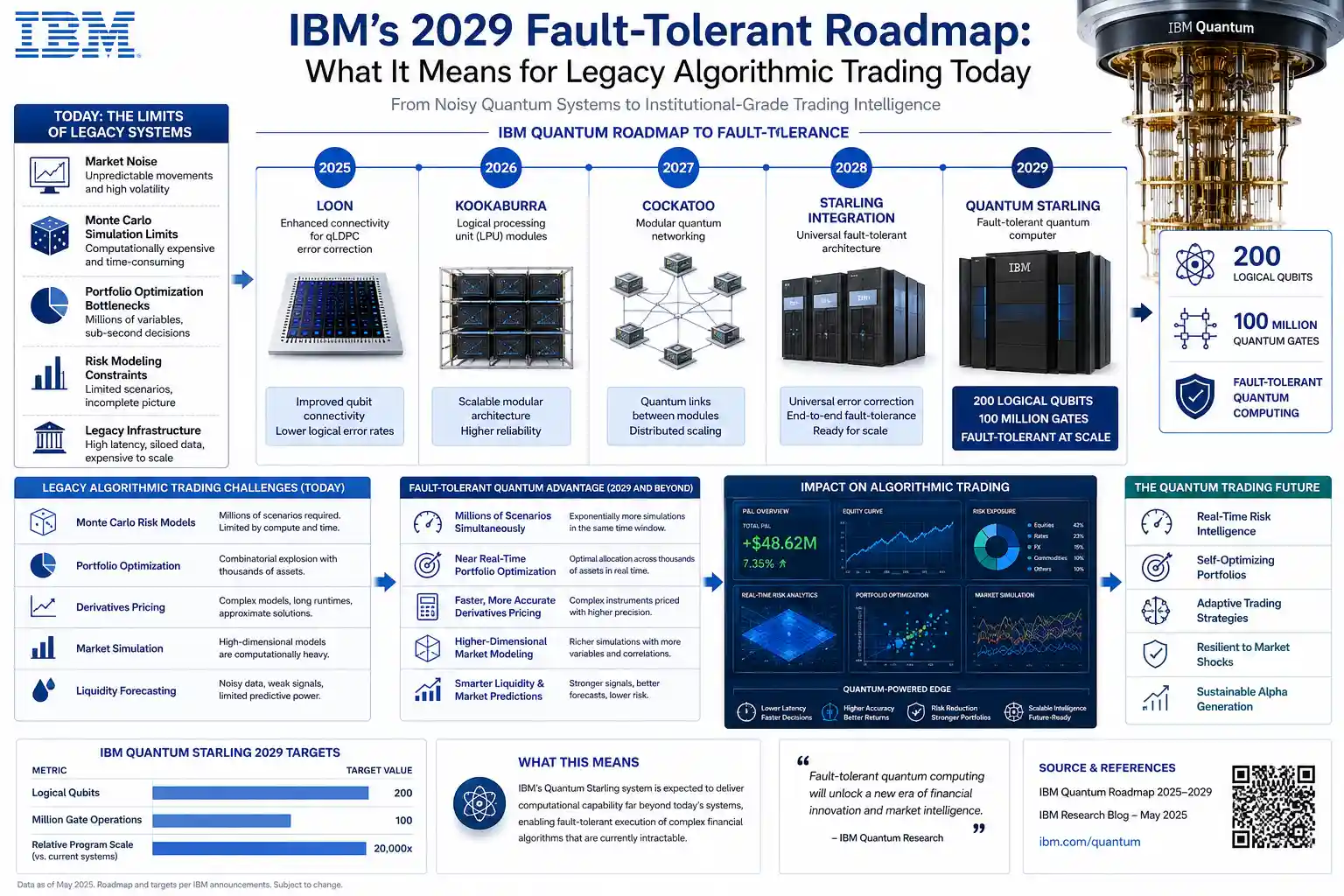
We are currently in the mid-2026 transition window. IBM has already moved past brute-force physical qubit scaling and is actively networking multi-chip modular processors. By 2029, their roadmap targets systems capable of executing hundreds of millions of quantum gates with active error correction.
If your fund’s alpha relies on complex derivatives pricing or deep statistical arbitrage, your current C++ and FPGA infrastructure is on a ticking clock.
The Core Threat: Why IBM’s 2029 Milestone Changes Quant Trading
What makes IBM’s 2029 quantum roadmap a threat to algorithmic trading?
IBM’s 2029 roadmap aims to deliver error-corrected, logical qubits capable of executing complex quantum algorithms without failing. For algorithmic trading, this means quantitative models that currently take classical supercomputer hours to process can be solved in minutes, destroying the alpha of firms relying on legacy compute speeds.
Legacy algorithmic trading relies on classical computing limits. You win by being closer to the exchange (latency) or by having slightly better hardware to process market data (compute).
Quantum computing doesn’t inherently fix latency. Fiber optics and FPGAs will still handle the final execution routing. Quantum breaks the compute bottleneck. When IBM achieves fault tolerance, meaning the system can correct its own calculation errors in real-time, it allows for deep circuit executions.
Funds utilizing these early FTQC systems will process multi-variable stochastic models exponentially faster than classical servers.
Logical Qubits vs. Physical Qubits in Financial Modeling
Why are logical qubits critical for quantitative financial modeling?
Physical qubits are highly unstable and prone to environmental noise, rendering them useless for precise financial calculations. Logical qubits, targeted for 2029, group multiple physical qubits together to correct errors in real-time, enabling the flawless execution of complex financial algorithms like deep Monte Carlo simulations.
Right now, in 2026, we are operating in the NISQ (Noisy Intermediate-Scale Quantum) era. The hardware is impressive but error-prone. You cannot trust a noisy qubit with a high-stakes algorithmic execution.
IBM’s 2029 target bridges this gap. By utilizing advanced topological codes, they are translating thousands of noisy physical qubits into stable “logical” qubits. A system with just 100 logical qubits can out-calculate classical supercomputers in specific combinatorial optimization tasks, exactly the kind of math required to optimize a massive, multi-asset portfolio under shifting market constraints.
Legacy Algorithmic Trading Vulnerabilities
Which algorithmic trading strategies are most vulnerable to quantum computing?
Strategies reliant on heavy probabilistic modeling are most vulnerable. This includes options pricing models, large-scale portfolio optimization, cross-asset statistical arbitrage, and risk limit calculations. High-frequency latency arbitrage is less vulnerable, as quantum computers excel at complex modeling rather than pure microsecond execution speed.
Not all trading desks will be disrupted equally. If your strategy relies on pure speed—co-locating servers next to the matching engine to front-run order flow—quantum won’t replace your FPGAs anytime soon. Quantum processors operate at cryogenic temperatures and require careful state preparation; they are not built for nanosecond reactivity.
However, if your strategy relies on finding hidden correlations across thousands of assets, your legacy systems are exposed.
The Monte Carlo Speedup: Options Pricing
How does fault-tolerant quantum computing change Monte Carlo simulations?
Fault-tolerant quantum computers utilize algorithms like Quantum Amplitude Estimation to process Monte Carlo simulations with a quadratic speedup. This allows quant funds to price complex, multi-variable exotic options in near real-time, whereas classical systems require hours of overnight batch processing.
Classical Monte Carlo simulations require immense brute force. To price a complex exotic derivative, legacy systems simulate millions of potential future market paths. The error rate shrinks slowly—at a rate of $O(1/\sqrt{N})$, where $N$ is the number of simulations.
Quantum algorithms change this scaling. Using Quantum Amplitude Estimation, the error scales at $O(1/N)$. A calculation that requires classical servers to run 1,000,000 paths can reach the same accuracy on a quantum computer in just 1,000 paths. The fund using the quantum system prices the asset, identifies the mispricing, and executes the trade while the classical fund is still running its first batch of simulations.
Statistical Arbitrage and Multi-Asset Correlation
How will quantum computing impact statistical arbitrage strategies?
Quantum computers can analyze massive, non-linear correlation matrices across thousands of global assets simultaneously. This enables quantum-backed funds to identify subtle, fleeting arbitrage opportunities across equities, commodities, and derivatives that classical algorithms simply cannot detect before the market window closes.
Finding pairs to trade in a basket of 500 stocks is mathematically trivial. Finding complex, non-linear correlations across 10,000 global equities, bonds, and derivatives simultaneously is a computational nightmare for classical systems.
Legacy systems take shortcuts. They use heuristics and machine learning approximations to guess the optimal state. A fault-tolerant quantum system doesn’t need to guess. It explores the entire solution space simultaneously, finding the absolute mathematical optimum for portfolio weighting and correlation anomalies.
The 2026 to 2029 Quantum-Classical Transition Strategy
How should quantitative hedge funds prepare for IBM’s 2029 quantum milestone?
Funds must immediately adopt a hybrid computing architecture. By refactoring legacy C++ code to interface with quantum APIs (like Qiskit) and building QPU-CPU execution routers, funds can delegate heavy mathematical modeling to quantum processors while keeping final trade execution on classical servers.
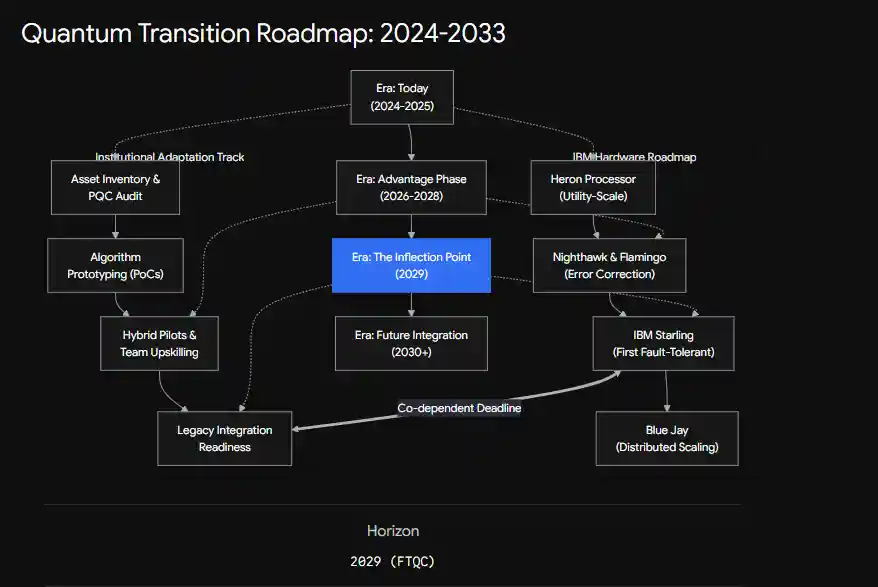
The most dangerous thing a CTO can do right now is wait for 2029 to arrive. The transition takes years. You cannot flip a switch and port millions of lines of proprietary C++ trading logic into quantum circuits overnight.
The winning playbook for the next 36 months is “Quantum-Classical Hybridization.”
| Strategy | Legacy Classical Approach | 2026-2029 Hybrid Approach |
| Heavy Math Processing | CPU/GPU server farms | Delegated to Quantum Processing Units (QPUs) |
| Trade Execution | Co-located FPGA | Co-located FPGA (Unchanged) |
| Data Routing | Monolithic C++ engines | API-driven classical-quantum middleware |
| Algorithm Design | Heuristic approximations | Quantum-native optimization algorithms |
Step 1: Hybrid QPU-CPU Execution Routing
What is hybrid QPU-CPU execution routing in algorithmic trading?
It is an architectural framework where an algorithmic trading system automatically routes heavy mathematical tasks (like probability modeling) to a Quantum Processing Unit via API, while latency-sensitive tasks (like order routing and risk checks) remain on local, high-speed classical CPUs.
You need to decouple your math from your execution. Right now, smart funds are building middleware. When the trading algorithm needs to update its correlation matrix, the middleware sends that specific task to an IBM quantum instance via the cloud. The QPU processes the optimization, returns the updated matrix to the classical server, and the local CPU executes the trades based on those new parameters.
Step 2: Qiskit Integration for Legacy C++ Systems
How do you integrate legacy C++ trading systems with quantum computers?
Developers must build API wrappers that allow legacy C++ trading infrastructure to communicate with quantum SDKs, primarily IBM’s Qiskit. This involves identifying specific computational bottlenecks in the classical code and rewriting those subroutines as quantum circuits callable via cloud endpoints.
Your quantitative researchers need to start thinking in qubits today. IBM’s Qiskit is the dominant framework. Start by taking a non-critical secondary strategy—perhaps an end-of-day portfolio rebalancing tool—and rewrite its core optimization logic using Qiskit.
Run it on classical simulators first, then run it on IBM’s current noisy quantum hardware. The goal isn’t to generate alpha today; the goal is to have the engineering pipelines built, tested, and ready for the exact moment fault-tolerance comes online.
Actionable Survival Checklist for Quant CTOs
If you are managing the technology stack for a proprietary trading firm or hedge fund, use this checklist to prepare for the 2029 timeline:
-
Conduct a Compute-Depth Audit: Identify which of your trading strategies are currently bottlenecked by classical processing time rather than network latency. These are your quantum targets.
-
Build the API Bridge: Stop writing monolithic code. Ensure your pricing engines can call external cloud APIs for specific mathematical functions.
-
Train the Quants: Classical physics and classical math are no longer enough. Your quantitative researchers must learn quantum linear algebra and topological error correction models.
-
Partner Early: Engage with the IBM Quantum Network or similar enterprise programs. Priority access to the newest quantum processors will be heavily restricted; you want your firm in the queue before 2029.
-
Protect the Data: While this article focuses on trading, remember that FTQC also threatens legacy encryption. Begin migrating your internal communications and data storage to post-quantum cryptographic standards immediately.
The funds that dominate the 2030s will be the ones that spent 2026 to 2029 building the bridges between their classical servers and the quantum future.