
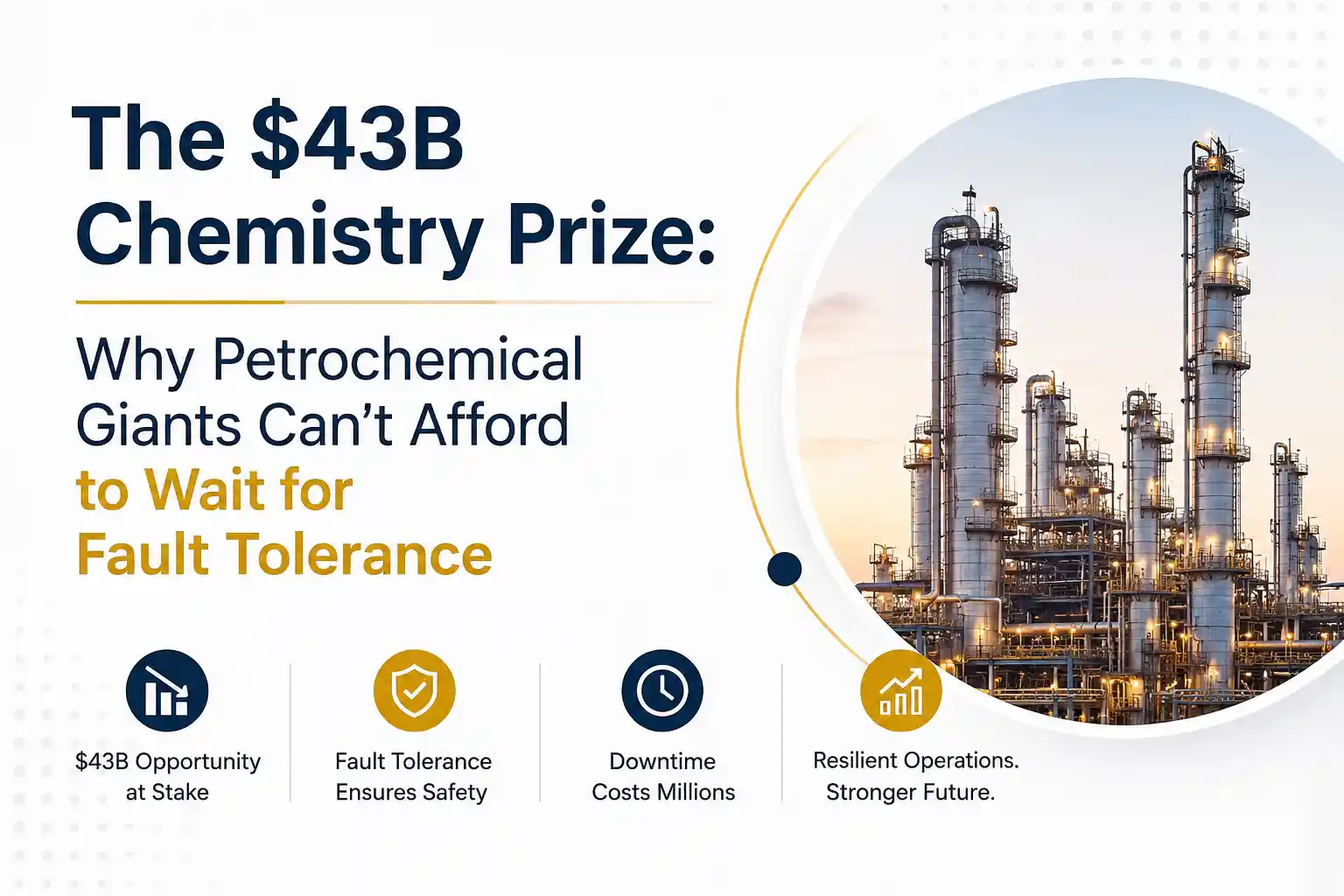
The $43B Chemistry Prize: Why Petrochemical Giants Can’t Afford to Wait for Fault Tolerance
For the last decade, the quantum computing narrative in heavy industry has been trapped in a holding pattern. Hardware vendors promised revolutionary breakthroughs, while corporate strategy teams decided to sit on their hands until “fault tolerance”, perfect, error-free quantum systems, finally arrived.
That waiting period ended in 2026.
The petrochemical sector is no longer treating quantum computing as a science project. Driven by an estimated $43 billion in near-term operational and R&D efficiencies, market leaders are actively deploying quantum-classical hybrid systems. They are discovering that you do not need perfect hardware to achieve a massive commercial advantage.
The Strategic Math Behind the $43 Billion Quantum Prize
The $43 billion quantum chemistry prize represents the near-term economic value generated by optimizing petrochemical processes. This value comes from reducing energy consumption in chemical separations, discovering highly efficient transition-metal catalysts, and slashing the computational time required for new polymer R&D workflows.
The petrochemical industry operates on microscopic margins applied to massive, global volumes. Even a fractional improvement in chemical synthesis efficiency translates to billions of dollars to the bottom line.

Classical high-performance computing (HPC) has hit a hard wall. Simulating the exact behavior of complex molecules—specifically those involving transition metals used in industrial catalysts—requires tracking electron interactions that scale exponentially. Classical supercomputers simply run out of memory trying to model anything beyond basic molecular structures.
The $43 billion figure isn’t derived from selling quantum software. It is the projected capital saved and generated across the sector by solving specific, high-value molecular bottlenecks over the next five years.
Catalyst Optimization: The Highest Yield Target
Catalyst optimization is the most lucrative immediate application for quantum chemistry. By accurately simulating molecular interactions that classical computers cannot handle, companies can design catalysts that lower the activation energy for chemical reactions, directly saving billions in industrial heating and pressurization costs.
Consider the Haber-Bosch process, which produces ammonia for global agriculture. It consumes roughly 1% to 2% of the world’s entire energy supply purely because the process requires extreme heat and pressure.
Finding a catalyst that allows this reaction to occur at room temperature has been computationally impossible. Classical algorithms rely on Density Functional Theory (DFT), which relies on approximations. These approximations fail when modeling the complex electron correlations found in novel catalysts. Quantum algorithms compute these correlations natively, offering a direct line of sight to breakthroughs that cut energy costs dramatically.
Why Waiting for Fault Tolerance is a Fatal Business Error
Waiting for fault-tolerant quantum computers is a fatal business error because early adopters are currently building insurmountable intellectual property moats. Companies utilizing near-term quantum systems today are securing patents on novel materials and algorithms, locking hesitant competitors out of the future market.
There is a persistent myth in corporate boardrooms that quantum computing will experience an “iPhone moment.” Executives assume they can wait for a fully mature, fault-tolerant system to hit the market, buy a license, and catch up to their competitors overnight.

This fundamental misunderstanding of quantum economics will bankrupt late adopters.
Quantum advantage is not a plug-and-play software update. It requires entirely new internal workflows, hybrid algorithms tailored to specific corporate datasets, and a workforce trained in quantum-native problem framing. Companies like Dow and ExxonMobil are not waiting for the 2030s. They are running algorithms on today’s noisy hardware to map their proprietary chemical problems to quantum circuits right now.
The IP Moat Created by Early Adoption
Early adoption creates an intellectual property moat by allowing companies to patent both the novel materials discovered via quantum simulation and the proprietary hybrid algorithms used to discover them. Competitors who wait for perfect hardware will find the most valuable chemical discoveries already legally protected.
When a petrochemical giant successfully maps a specific catalyst simulation to a quantum processor, they don’t just get a faster answer. They own the method of getting that answer.
By the time a wait-and-see competitor buys a fault-tolerant machine in 2032, the early adopter will have a five-year head start on patenting the specific molecular structures those machines are best at finding.
How Chemical Leaders Extract Value from Noisy Quantum Hardware
Direct Answer: Chemical leaders extract value from noisy quantum hardware by abandoning pure quantum approaches. Instead, they use hybrid quantum-classical workflows, delegating only the most complex molecular electron correlation tasks to the quantum processor while traditional supercomputers handle the bulk of the standard chemistry simulation.
We are currently in the era of advanced error mitigation. The hardware is still susceptible to environmental noise, but software techniques have improved dramatically.
You no longer need millions of physical qubits to get a useful answer. Modern hybrid algorithms, such as advanced versions of the Variational Quantum Eigensolver (VQE), act as a bridge. The classical computer does 95% of the heavy lifting. When it encounters a highly correlated electron problem it cannot solve, it hands just that specific mathematical knot to the quantum processing unit (QPU).
Bridging the Gap with Quantum Error Mitigation (QEM)
Direct Answer: Quantum Error Mitigation bridges the gap to fault tolerance by using advanced software algorithms to mathematically cancel out hardware noise. This allows petrochemical companies to extract highly accurate chemical simulations from imperfect quantum processors, generating commercial value years ahead of strict hardware perfection.
Error correction requires massive hardware overhead—often 1,000 physical qubits to create a single, stable “logical” qubit. Error mitigation, however, is a software play.
By running a quantum circuit multiple times and applying classical machine learning to model the noise profile, engineers can essentially filter out the errors after the fact. This technique is allowing chemical companies to accurately model small, highly impactful molecules right now, proving that the hardware no longer needs to be perfect to be profitable.
The CTO’s Playbook: Building a Hybrid Quantum-Classical Workflow
Direct Answer: To build a hybrid workflow, CTOs must integrate quantum processing units seamlessly into their existing classical high-performance computing infrastructure. This requires shifting from traditional chemistry solvers to hybrid algorithms and training chemical engineers to frame molecular problems specifically for tensor networks and quantum execution.
Implementing a quantum chemistry strategy today requires a highly pragmatic approach. It is not about replacing your classical HPC clusters; it is about augmenting them.
Here is the current implementation framework for enterprise adoption:
| Implementation Phase | Action Required | Business Value |
| 1. Problem Triage | Audit current computational bottlenecks. Identify which simulations fail due to complex electron correlations (e.g., transition metals). | Stops wasted spending on classical HPC cycles that yield inaccurate approximations. |
| 2. Algorithm Mapping | Partner with quantum software vendors to translate these specific bottlenecks into quantum-native circuits. | Builds the proprietary IP moat around custom algorithmic workflows. |
| 3. Hybrid Execution | Deploy a hybrid cloud architecture linking existing classical GPU clusters directly to remote QPUs. | Achieves near-term computational acceleration without massive hardware CapEx. |
The companies winning this race are treating quantum processors as specialized accelerators, much like how GPUs were treated a decade ago before they dominated the data center.
Conclusion: The Cost of Doing Nothing
The narrative that quantum computing is “a decade away” is an outdated comfort blanket for risk-averse executives. The $43 billion prize in materials and petrochemical optimization is actively being carved up by early adopters using today’s error-mitigated, hybrid systems.
Fault tolerance will eventually arrive, but it will not level the playing field. It will simply act as a force multiplier for the companies that have already spent the last five years integrating quantum workflows into their core R&D pipelines. In the high-stakes chemistry sector, waiting for perfection is the fastest path to irrelevance.