
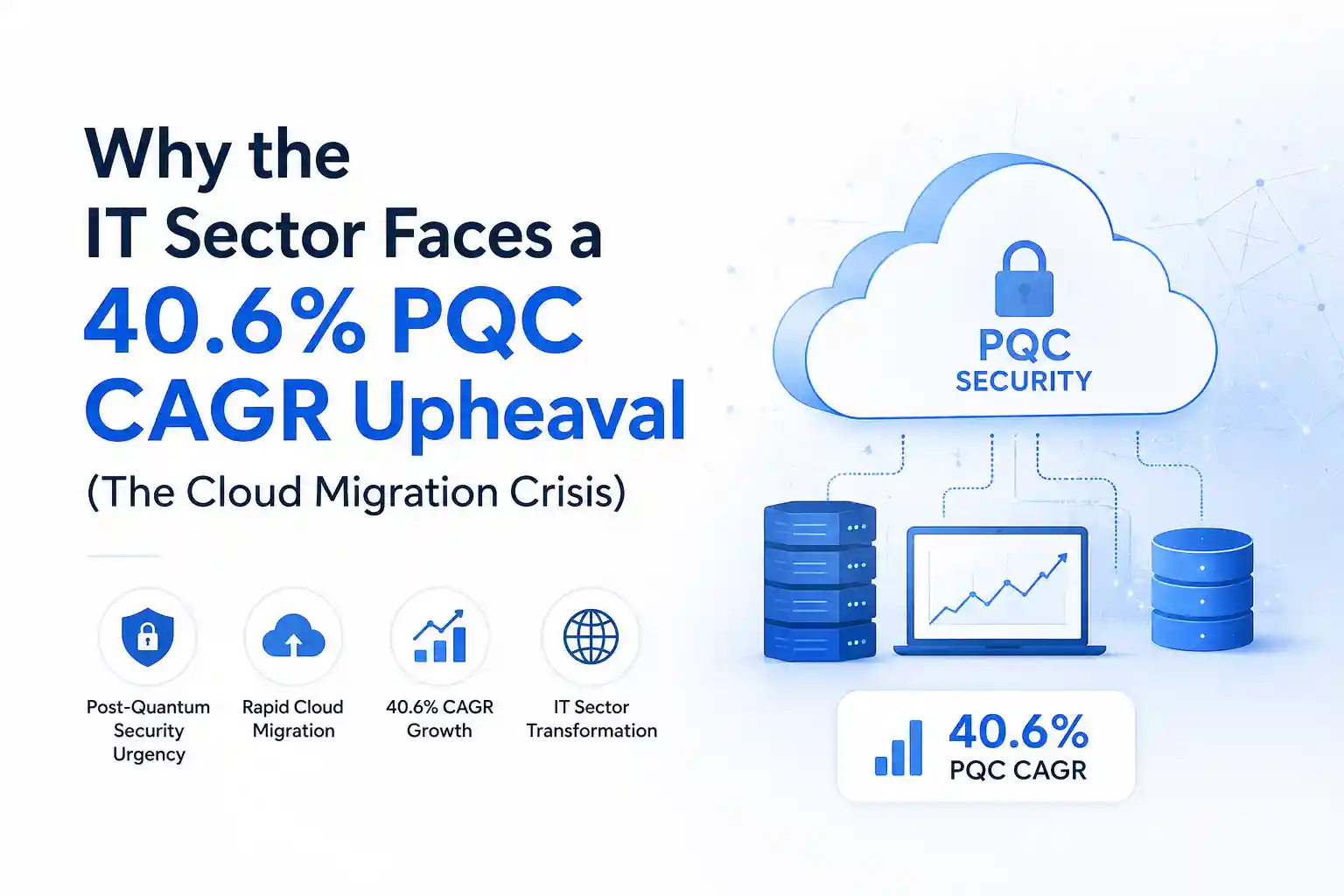
Why the IT Sector Faces a 40.6% PQC CAGR Upheaval (The Cloud Migration Crisis)
The enterprise IT sector is currently trapped between two massive tectonic plates: the mandate to migrate legacy systems to the cloud, and the urgent necessity of Post-Quantum Cryptography (PQC).
Analysts are tracking a staggering 40.6% Compound Annual Growth Rate (CAGR) in the PQC market. But this isn’t organic tech adoption. It is a forced rip-and-replace cycle triggered by the finalized NIST algorithms and the realization that quantum computers will soon render RSA and ECC encryption obsolete. Organizations lifting and shifting legacy crypto into modern clouds are unknowingly building massive technical debt.
The Math Behind the 40.6% CAGR: Panic, Not Progress

What is driving the 40.6% PQC CAGR in the IT sector?
The 40.6% PQC CAGR upheaval is driven by the urgent need to replace vulnerable legacy encryption across global IT infrastructure. Triggered by imminent quantum computing threats and finalized NIST standards, organizations are aggressively reallocating budgets to secure data against emerging quantum decryption capabilities.
The explosive growth in PQC spending isn’t about acquiring a shiny new feature. It is an infrastructure tax. IT leaders are scrambling to secure budgets for a problem that produces zero new revenue but carries existential risk.
When NIST finalized FIPS 203, 204, and 205, the timeline for quantum compliance shifted from a theoretical “someday” to an actionable “now.” Regulatory bodies are already drafting compliance penalties for failing to adopt quantum-safe standards.
Harvest Now, Decrypt Later (HNDL) is Bleeding Data
What is a Harvest Now, Decrypt Later (HNDL) attack?
A Harvest Now, Decrypt Later (HNDL) attack occurs when adversaries steal and stockpile strongly encrypted, sensitive data today. Their goal is to store this unreadable data until quantum computers become powerful enough to break the encryption, revealing the information in the future.
If your data has a shelf life of more than five years (health records, national security, financial ledgers), it is already vulnerable. Nation-state actors are actively skimming encrypted traffic passing between on-premise data centers and cloud environments.
Migrating to the cloud without PQC means you are essentially packaging your data and handing it over to adversaries who are patiently waiting for Cryptographically Relevant Quantum Computers (CRQCs) to come online.
Why PQC Breaks Traditional Cloud Migrations
How does Post-Quantum Cryptography impact cloud migrations?
Post-quantum cryptography severely impacts cloud migrations by increasing encryption key sizes and computational requirements. This causes network latency, breaks legacy TLS handshakes, and significantly inflates cloud egress costs, forcing IT teams to fundamentally re-architect infrastructure rather than simply lifting and shifting workloads.

Most IT teams treat cryptography as an invisible layer. In a standard cloud migration, you move the workload, wrap it in a standard TLS 1.3 tunnel using ECC, and forget about it. PQC destroys this workflow.
The Payload Penalty: Network Latency and Egress Costs
Why do PQC algorithms cause network latency?
PQC algorithms cause network latency because their public keys and ciphertexts are vastly larger than traditional RSA or ECC keys. This payload bloat requires more bandwidth, splits packets during transmission, and increases the time required to complete secure TLS handshakes across networks.
Look at the math. A traditional ECC public key is small, roughly 32 bytes. ML-KEM (Kyber), the new standard for key encapsulation, requires a public key over 1,000 bytes.
When you multiply this byte increase by millions of microservices talking to each other across a distributed cloud architecture, the network strain is massive.
| Metric | Traditional (ECC P-256) | Post-Quantum (ML-KEM-768) | Impact |
| Public Key Size | 32 bytes | 1,184 bytes | Significant payload bloat |
| Ciphertext Size | 32 bytes | 1,088 bytes | Slower transmission times |
| Handshake Speed | Milliseconds | Noticeably slower | Load balancer timeouts |
This isn’t just a latency problem; it’s a billing problem. Cloud providers charge for egress data. PQC mathematically guarantees your egress payload will be larger.
The Hardcoded Cryptography Trap
What is the hardcoded cryptography problem in IT?
The hardcoded cryptography problem occurs when developers embed specific encryption algorithms directly into application code. When these legacy algorithms must be updated to post-quantum standards, organizations are forced to manually rewrite millions of lines of code, delaying critical cloud migrations and deployments.
The biggest mistake enterprise architects make today is migrating applications with hardcoded RSA dependencies. If an application explicitly calls for an RSA key generation in its code, throwing it into a modern cloud environment won’t save it.
You must decouple the application logic from the cryptographic logic before the migration occurs.
Enterprise Survival: Achieving Cryptographic Agility
What is cryptographic agility in cloud security?
Cryptographic agility is the architectural ability to rapidly swap out underlying encryption algorithms without disrupting the application or network infrastructure. It is essential for transitioning from legacy RSA/ECC to new PQC standards during ongoing cloud migrations without causing system downtime.
The solution to the PQC upheaval is not to stop your cloud migration. The solution is to mandate “crypto-agility” as a prerequisite for any workload moving off-premise.
You need an abstraction layer. Applications should request “a secure connection,” not “an RSA-2048 connection.” This allows the infrastructure team to update the cryptographic provider underneath the application layer without requiring a code rewrite.
Hybrid Cryptography Models for Phased Rollouts
How does hybrid cryptography work for PQC?
Hybrid cryptography combines traditional algorithms, like ECC or RSA, with new post-quantum algorithms, like ML-KEM, within the same secure connection. This ensures compliance with existing security standards while providing immediate protection against future quantum decryption threats during the transition period.
Do not attempt a hard cutover. The most effective strategy currently deployed by top-tier engineering teams is the hybrid model. By using a traditional algorithm alongside a PQC algorithm, you maintain FIPS compliance for today while insulating the data against the HNDL threats of tomorrow.
If the new PQC algorithm is unexpectedly broken by cryptanalysts, the traditional algorithm still holds the line.
How to Protect Your Cloud ROI in the PQC Era
How can companies protect cloud investments from quantum threats?
Companies can protect cloud investments from quantum threats by inventorying all cryptographic assets, adopting hybrid encryption models, budgeting for increased compute and bandwidth costs, and requiring cloud service providers to demonstrate native support for NIST’s finalized post-quantum algorithms.
Ignore the vendor noise and focus on your architecture.
Audit First: Run automated discovery tools to find every instance of weak cryptography in your network. You cannot secure what you cannot see.
Update the Load Balancers: Ensure your cloud edge (WAFs, Load Balancers, API Gateways) can handle fragmented packets and longer TLS handshakes without timing out.
Challenge your CSP: Demand transparency from AWS, Azure, and Google Cloud on their PQC roadmaps. If they aren’t ready to support ML-KEM natively, your migration timeline is at risk.
The 40.6% PQC CAGR is a reflection of the survival cost in the modern IT landscape. Treat your cloud migration and your quantum preparation as a single, unified architectural overhaul, or prepare to pay for the migration twice.